Chat on WhatsApp

Google Ads vs Meta Ads in India: Platform Guide 2026

Google Ads captures intent, Meta creates it. Which one fits your funnel, typical Indian CPMs and CPCs, and why most SMBs burn ₹50K before figuring it out.

20 April 2026 Updated 28 Apr 2026 10 min read
Key Takeaways
  • Google Ads is stronger for visible demand and search intent; Meta Ads is stronger for discovery, retargeting, and creative-led demand creation.
  • Choose the channel based on funnel stage, offer type, margin, landing page quality, and whether customers already search for the solution.
  • Measure CAC, conversion rate, lead quality, and payback before shifting budget between Google and Meta.
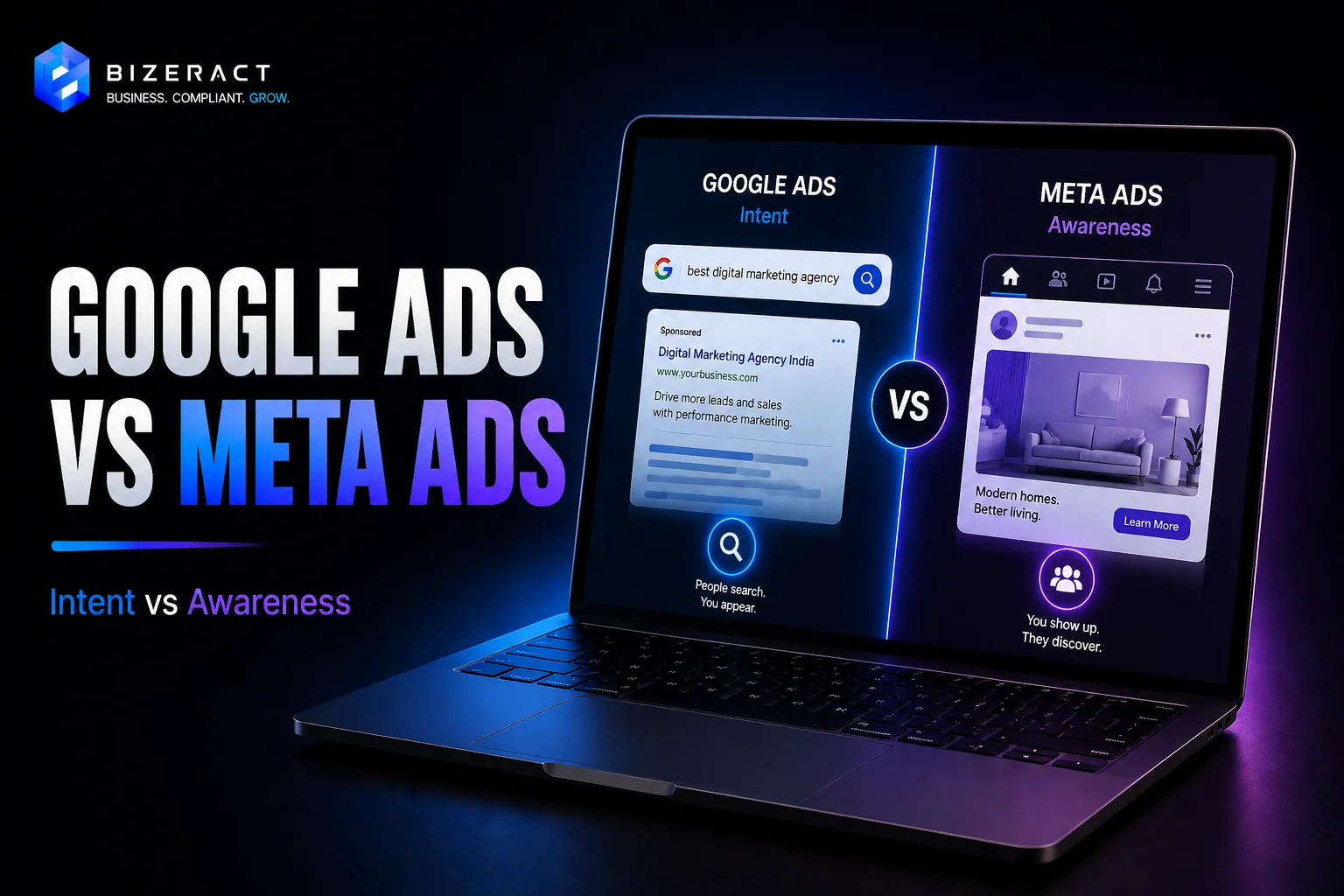
Google Ads vs Meta Ads visual comparing search intent and social media awareness campaigns

Google Ads vs Meta Ads is not a religious war - it's a funnel-stage question. Google captures people who already want your thing. Meta creates the want. Most SMBs burn ₹50K figuring this out. Here are the rules, the real Indian CPMs, and which platform to start with for your business.

The one-line rule

High-intent, searched queries → Google. Visual, impulse, scroll-stopping → Meta. A GST consultancy belongs on Google. A handmade candle brand belongs on Meta. Both can work on both - but one is leverage, one is homework.

Typical Indian 2026 benchmarks

  • Google Search CPC: ₹8 (branded, long-tail) to ₹350 (insurance, loans, legal)
  • Google Display CPM: ₹40–₹150
  • Meta (Facebook + Instagram) CPM: ₹80–₹250
  • Meta CPC: ₹3–₹25 (feed), ₹5–₹40 (Reels)
  • YouTube TrueView CPV: ₹0.30–₹1.20

Meta's CPMs are 2–3× lower, but Google's conversion rate is 3–5× higher. Cost-per-conversion usually lands in the same band - the funnel stage differs.

When Google Ads wins

  • Service businesses (CA, lawyer, plumber, gym, clinic) - keyword intent is explicit
  • B2B SaaS with a known category
  • High-ticket purchases (>₹50K) where buyers research
  • Urgent needs ("AC repair near me")

When Meta Ads wins

  • D2C products with strong visuals
  • New categories nobody searches for yet ("mushroom coffee")
  • Impulse purchases under ₹2,000
  • Retargeting / LTV expansion on existing customers

The mistake SMBs make

They run both simultaneously from day one with ₹10K/mo per platform. That's not enough budget on either to exit the learning phase. Pick the one that matches your funnel, spend ₹30K–₹50K to get signal, then layer the second.

See how we run Google and Meta ads for Indian SMBs - or use our ROAS calculator to sanity-check your current numbers first.

What should you verify before using this Ad Strategy guide?

Before acting on google ads vs meta ads in india, verify the current rules or platform behavior with the Google Ads Help. The practical answer depends on your business model, state, turnover, documents, software stack, and whether the decision affects tax, customer data, paid media spend, or a production workflow.

Use this article as a working checklist, then confirm campaign policy, billing settings, attribution windows, conversion tracking, and platform changes. In our audits, most expensive mistakes do not come from ignoring the whole process. They come from one stale assumption, one mismatched address, one missing event, or one automation path that nobody tested after launch.

CheckpointWhy it mattersWhere to confirm
Current rule or platform statusLimits, forms, policies, and APIs can change after a blog update.Google Ads Help
Your exact business caseA local shop, freelancer, D2C store, agency, and SaaS team rarely need the same next step.Documents, invoices, campaign data, analytics setup, or workflow logs
Implementation evidenceThe safest campaign decision is backed by proof, not memory or screenshots from an old setup.Portal acknowledgement, dashboard export, invoice sample, test lead, or error log

How do we apply this in real business work?

We start with the smallest decision that can be verified. For compliance work, that means matching PAN, address, bank, invoices, and portal status before filing. For websites, marketing, analytics, and automation, it means testing the real user path from first click to final record. The boring checks catch the costly failures.

A useful rule: if a claim changes money, tax, reporting, or customer communication, keep evidence for it. Save the acknowledgement, export the report, test the form, and note the date you verified the source. That gives you a clean trail when a client, officer, platform, or internal team asks why the setup was done that way.

When should you get expert review?

Get expert review when the next action can create tax exposure, lost reporting data, ad waste, broken customer communication, or production downtime. A simple self-check is enough for low-risk learning. A filed return, new registration, tracking migration, paid campaign restructure, or live automation deserves a second set of eyes before it affects customers or records.

How often should this be rechecked?

Recheck the decision whenever your turnover, state, product mix, campaign budget, website stack, analytics property, or workflow ownership changes. Also recheck it after major portal updates, platform policy changes, annual filing deadlines, and vendor migrations. The guide is useful today only if the facts behind it still match your business.

What is the fastest safe way to decide?

Write the decision in one sentence, list the proof needed for that sentence, and verify only those items first. This keeps the work focused. If the proof confirms the decision, proceed. If one item is unclear, pause and resolve that point before changing filings, campaigns, tracking, website code, or automation logic.

What can go wrong if you skip verification?

The usual failure is not dramatic at first. It looks like a rejected application, a wrong tax invoice, a missing conversion, a duplicate lead, a broken report, or a workflow that silently stops. Those small failures become expensive when nobody notices them until month-end reporting, filing day, or a customer escalation.

What evidence should you keep after making the change?

Keep enough evidence to reconstruct the decision later. For a compliance topic, that usually means the application reference number, registration certificate, invoice sample, return acknowledgement, payment challan, notice reply, or source link checked on the day of filing. For a website, campaign, analytics setup, or automation, keep the before-and-after screenshot, test submission, dashboard export, webhook log, and the exact setting that changed.

This matters because most business fixes are revisited months later, when nobody remembers the original reason. A short evidence trail makes audits faster, handovers cleaner, and vendor conversations more precise. It also keeps the advice in this guide tied to your real operating context instead of becoming a generic checklist that gets copied without review.

  • Date checked: record when the official source, dashboard, or portal screen was reviewed.
  • Business context: note the entity, state, product, campaign, property, or workflow affected.
  • Proof of action: save the acknowledgement, report export, test result, or live URL.
  • Owner: assign one person to re-check the item when rules, tools, or business volume change.
Verification workflowUse this loop before changing money, tax, reporting, or customer communication.1234Check sourceMatch recordsTest actionSave proof
Repeat this check whenever rules, platform settings, business volume, or ownership changes.

Which next step should you take after reading this?

Turn the article into one action list. Mark what is already true, what needs proof, and what needs expert review. If you want to go deeper, compare this guide with Google Ads Management, Meta Ads Management, and Marketing Dashboards. Then update the decision only after the official source and your own records agree.

Frequently asked questions

What is the short answer on Google Ads vs Meta Ads in India?

Google Ads captures intent, Meta creates it. Which one fits your funnel, typical Indian CPMs and CPCs, and why most SMBs burn ₹50K before figuring it out. The practical next step is to compare the article checklist with your business model, state, turnover, documents, and tools before you act.

What should I verify before using this guide?

Verify the latest platform policies, ad costs, consent rules, campaign data, and account settings from the official source links on this page. Tax rules, ad platform policies, software APIs, marketplace requirements, and search documentation can change after publication.

When should I get professional help?

Get help when the decision affects GST registration, tax filing, paid media budget, production website performance, analytics accuracy, or business-critical automations. A short expert review usually costs less than penalties, rework, bad data, or failed implementation.

Let's Talk

Let's talk about your business.

Tell us what you're working on and where you want to go. We'll put together a plan. No obligation, no sales pitch.

  • Free 30-minute call
  • A plan built around your goals
  • No obligation, no pressure
  • Your own account manager

By submitting, you agree to our privacy policy. We'll never spam you.