International Finance Operations Guides
Monthly close, bookkeeping, cash-flow visibility, AP/AR, payment reconciliation, and finance dashboards are the operating layer behind cleaner global growth. These guides focus on the systems, controls, and reporting habits that keep founders out of spreadsheet chaos.
Legacy India compliance guides remain available for search visitors, but the primary editorial direction is now international finance operations for global SMEs.

ITR-U Now Has a 48-Month Window: How to Fix Old Tax Returns in 2026
The Finance Act, 2025 doubled the Updated Return (ITR-U) window from 24 to 48 months from 1 April 2025. You get more time to correct old returns — but the additional tax rises from 25% to 70% the longer you wait. Here is how Section 139(8A) works now.
Read article
TDS and TCS Threshold Changes from 1 April 2025: What Small Businesses Must Update
The Finance Act, 2025 raised TDS thresholds on rent, commission, professional fees, interest and dividend, removed TCS on the sale of goods, and lifted the TCS limit on foreign remittance. Here is the section-by-section before-and-after for FY 2025-26.
Read article
GSTR-3B Is Now Locked and Old Returns Are Time-Barred: The 2026 GST Filing Reset
Your GSTR-3B liability is now auto-populated from GSTR-1 and non-editable, and GST returns more than three years past due can no longer be filed. Combined with sequential filing and mandatory IMS from April 2026, GST filing has become far less forgiving. Here is what changed.
Read article
ITR Filing AY 2026-27: New August 31 Deadline for Small Businesses and Professionals
For the first time, ITR deadlines are staggered by form type — salaried filers stay at July 31, non-audit business and professional filers get until August 31, 2026. Here is what changed under the Finance Act, 2026 and what to do.
Read article
GST 2.0 for Small Businesses: The 5%, 18% and 40% Slab Reset and Your FY 2026-27 Checklist
The 56th GST Council collapsed four slabs into two main rates — 5% and 18% — plus a 40% sin/luxury rate, effective 22 September 2025. Here is what the GST 2.0 reset means for your pricing, ITC, and FY 2026-27 invoice housekeeping.
Read article
The MSME 45-Day Payment Rule (Section 43B(h)): What Small Buyers and Suppliers Must Get Right
Section 43B(h) disallows your tax deduction for payments to Micro and Small enterprises unless paid within 15 or 45 days. The 45-day cap is absolute. Here is how the rule works and what to fix before year-end.
Read article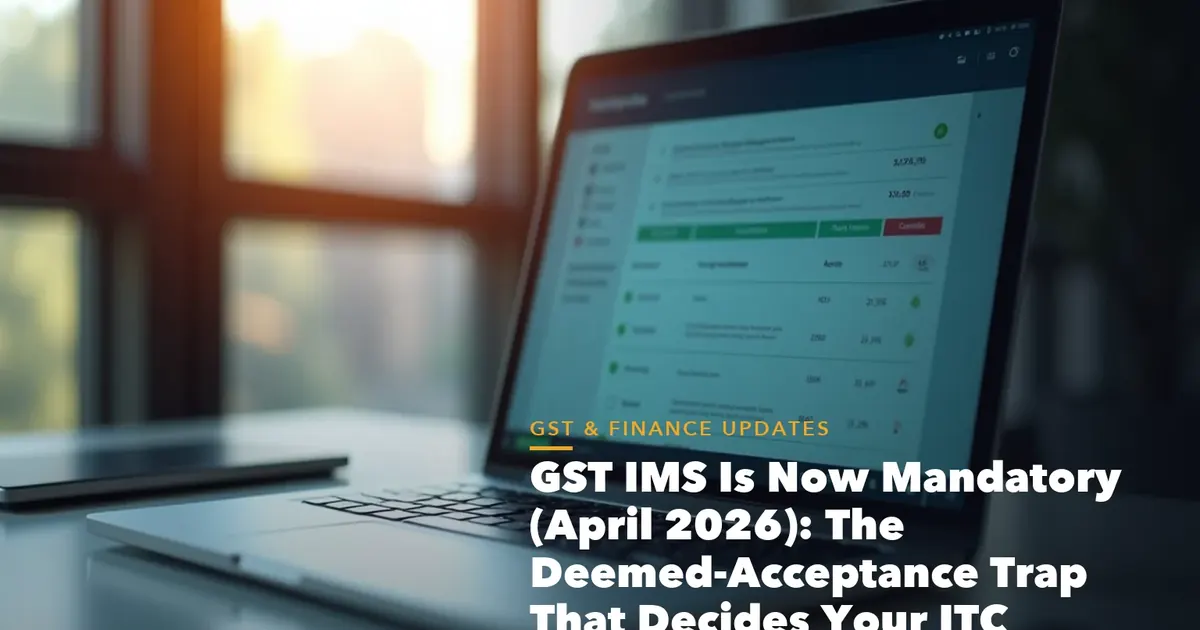
GST IMS Is Now Mandatory (April 2026): The Deemed-Acceptance Trap That Decides Your ITC
From 1 April 2026 the Invoice Management System (IMS) is mandatory for all regular GSTR-3B filers, and Section 38 ties your ITC to accepted invoices. Inaction now equals acceptance — here is how IMS works and how to avoid the costly mistakes.
Read article
GST E-Invoicing in 2026: The ₹5 Crore Threshold and the 30-Day Reporting Clock Explained
E-invoicing is mandatory once your turnover crosses ₹5 crore in any year since 2017-18, and businesses above ₹10 crore must report invoices to the IRP within 30 days or lose the IRN. Here is who must comply and how to avoid blocked invoices.
Read article
E-Way Bill 2FA Is Mandatory: What Every Business and Transporter Must Set Up
Since 1 April 2025, two-factor authentication is mandatory for all taxpayers and transporters on the NIC e-way bill and e-invoice portals — regardless of turnover. Here is how the OTP options work and the GST-portal nuance most people miss.
Read articleLet's talk about your business.
Tell us what you're working on and where you want to go. We'll put together a plan. No obligation, no sales pitch.
- Free 30-minute call
- A plan built around your goals
- No obligation, no pressure
- Your own account manager