Can I File ITR Without a CA? (Honest Answer for 2026)
43.82% of Indians filed their ITR directly online - no CA needed. Which income profiles are safe to DIY, when a CA earns their fee, and real CA fee data vs portal (₹0).
- 71.54% of all AY 2024-25 ITRs were ITR-1 or ITR-4 - both designed for self-filing by salaried individuals and freelancers (PIB/CBDT, 2024).
- Salaried employees earning salary + interest income only (ITR-1) can safely file themselves in 20–30 minutes on incometax.gov.in - no CA needed.
- Freelancers under Section 44ADA (gross receipts ≤ ₹50 lakh) can file ITR-4 without maintaining books of accounts - the portal handles most of the math.
- CA fees for ITR-1 range from ₹500–₹2,500 at market rates; ICAI-recommended minimums are ₹4,000–₹8,000. The portal does the same thing for ₹0.
- You genuinely need a CA for foreign assets, F&O trading losses, scrutiny notices, or income from multiple countries.
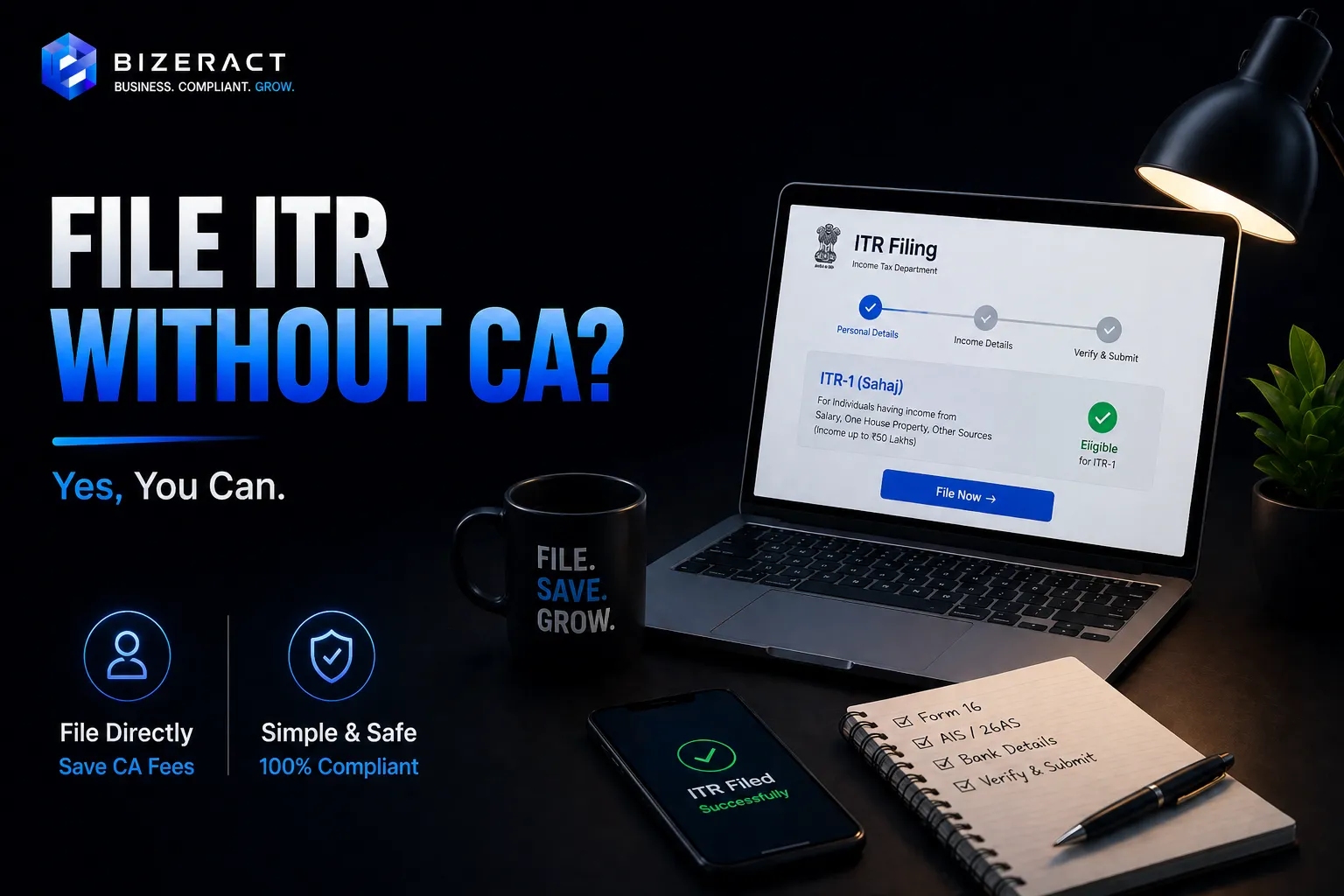
43.82% of all ITRs filed in AY 2024-25 were submitted directly through the income tax portal's online utility - no CA, no intermediary, no fee (PIB/CBDT, Aug 2024). ITR-1 and ITR-4 together account for 71.54% of all returns filed in India, and both are designed for straightforward income situations that most salaried employees and freelancers face. So yes - you can file ITR without a CA. But whether you should depends on your income profile, not your comfort level with forms.
Can a normal person file ITR online without a CA?
Yes - and most do. ITR-1 (Sahaj) covered 3.34 crore filers in AY 2024-25, making it the most filed return form in India (PIB/CBDT, Aug 2024). The portal at incometax.gov.in pre-fills your salary from Form 16, your TDS from Form 26AS, and your bank interest from bank-reported data. For a salaried person with one employer, no capital gains, and no foreign income, the process involves reviewing pre-filled figures and clicking submit.
The honest answer most CAs won't tell you: for ITR-1, you're paying a CA to review data the portal already populated from government records. There's no secret analysis involved. The skill gap is minimal - and closing it takes one careful read of your Form 16 against your portal screen.
Where CAs genuinely earn their fees is in complex situations: capital gains tax calculations, foreign asset disclosures, business income with audit requirements, and responding to income tax notices. For these, getting it wrong costs far more than the CA's fee.
When is DIY ITR filing safe?
71.54% of India's ITR filers use ITR-1 or ITR-4 - the two simplest forms, built for exactly the scenarios where a CA adds the least value (PIB/CBDT, 2024). Here's where self-filing is clearly safe:
| Income profile | Correct form | DIY difficulty |
|---|---|---|
| Salaried employee, one employer, salary + bank interest only, income ≤ ₹50 lakh | ITR-1 (Sahaj) | Easy - portal pre-fills most data from Form 16 |
| Freelancer / consultant using Section 44ADA presumptive taxation, gross receipts ≤ ₹50 lakh | ITR-4 (Sugam) | Moderate - declare 50% of gross receipts as income, no books required |
| Small trader using Section 44AD presumptive taxation, turnover ≤ ₹3 crore | ITR-4 (Sugam) | Moderate - same presumptive logic, declare 6–8% of turnover as profit |
| Salaried with house property rental income (one property only) | ITR-1 | Easy - rental income schedule available in ITR-1 |
Section 44ADA is the biggest DIY enabler most Indian freelancers don't know about. IT consultants, graphic designers, doctors, lawyers, architects, and other specified professionals with gross receipts under ₹50 lakh (or ₹75 lakh if 95%+ payments are digital) can declare exactly 50% of their gross income as taxable profit - no expense tracking, no account books, no audit. The remaining 50% is treated as your business expenses by default. They file ITR-4, which the portal largely pre-fills.
A freelance developer earning ₹30 lakh gross in FY 2025-26 pays tax on ₹15 lakh under 44ADA - and can file their ITR-4 in under 45 minutes on the portal with no CA and no paperwork beyond their bank statement.
When do you genuinely need a CA?
About 1.65 lakh ITRs were flagged for scrutiny in FY 2024-25 - roughly 3–4 times the normal annual volume, driven by AI-based risk filters CBDT deployed (ClearTax, 2025). Scrutiny means an Assessing Officer reviews your return in detail and can demand records. In these situations, having a CA who understands Section 143(2) proceedings isn't optional - it's damage control.
Beyond scrutiny, here's when a CA genuinely earns their fee:
- Foreign assets (Schedule FA): Non-disclosure of foreign accounts or assets under the Black Money Act carries a flat ₹10 lakh penalty per undisclosed asset - plus potential imprisonment up to 7 years. A CA familiar with FEMA and DTAA treaties is not optional here.
- F&O and intraday trading losses: Futures & options income is treated as non-speculative business income, requiring ITR-3 with full P&L. Loss carry-forward requires on-time filing of a verified return - an error here wastes potentially lakhs in future loss offset.
- Capital gains from unlisted shares or property: Indexation, cost of improvement, sale deed valuation - these calculations have significant scope for legitimate tax reduction that self-filers routinely miss.
- NRI filing with DTAA claims: Double Taxation Avoidance Agreement relief requires treaty-specific filings - a missed DTAA claim means paying tax twice on the same income.
- Business turnover requiring audit: If gross turnover exceeds ₹1 crore (business) or ₹50 lakh (professional) under presumptive schemes, a tax audit under Section 44AB is mandatory - only a CA can sign off on it.
- Receiving a Section 143(2) notice: If you get a scrutiny notice, stop. Responding incorrectly or incompletely compounds the problem. Get a CA experienced in assessment proceedings before replying.
How much do CAs charge for ITR filing in India?
ICAI (Institute of Chartered Accountants of India) publishes recommended minimum fee guidelines for professional services. For individual ITR filing, the recommended floor is ₹4,000–₹8,000 in Class A cities (metro cities), ₹4,000–₹6,000 in Class B cities, and ₹4,000+ in Class C cities (TaxScan, citing ICAI CMP, 2024). These are floors, not ceilings. In practice, individual CAs charge based on return complexity, their own seniority, and client relationship.
| ITR type | Market rate (local CA) | Online platform (CA-assisted) | Portal DIY |
|---|---|---|---|
| ITR-1 (salary only) | ₹500 – ₹2,500 | ₹1,274 – ₹1,299 (ClearTax / Tax2win) | ₹0 |
| ITR-4 (presumptive business/professional) | ₹500 – ₹2,500 | ₹799 – ₹1,274 | ₹0 |
| ITR-2 (capital gains, multiple properties) | ₹3,000 – ₹5,000 | ₹3,999 – ₹7,968 | ₹0 |
| ITR-3 (business income, F&O trading) | ₹4,000 – ₹10,000 | ₹3,999 – ₹7,968 | ₹0 (not recommended without guidance) |
Notice the gap between ICAI's recommended minimums (₹4,000+) and actual market rates for ITR-1 (₹500–₹2,500). Most individual CAs price below ICAI guidelines to stay competitive. If you're quoted ₹5,000+ for a basic salaried ITR-1 with no complexity, that's above market.
The more useful comparison isn't CA vs portal - it's CA vs online platform. Platforms like ClearTax, Tax2win, and Quicko offer CA-assisted filing at ₹1,274–₹3,999 with faster turnaround and digital document handling. For complex returns where you want human review but not a local CA relationship, they're often the best middle path.
What's the penalty if you make a mistake in your ITR?
The Income Tax Act distinguishes between honest mistakes and deliberate misreporting - and the penalties differ dramatically. Under Section 270A (ClearTax, 2025):
- Under-reporting income (forgot to include interest income, missed a source): Penalty = 50% of the tax amount on the under-reported income. Example: if you under-reported ₹1 lakh in income and the tax on it is ₹30,000, the penalty is ₹15,000.
- Misreporting (false records, fraudulent deductions, suppressed income): Penalty = 200% of the tax on the misreported amount. This is the difference between a mistake and fraud in the eyes of the Assessing Officer.
- Missing a foreign asset disclosure: ₹10 lakh flat penalty per asset under the Black Money Act - regardless of whether any tax was owed.
For ITR-1 filers, the realistic penalty risk is low if you report everything the portal shows in your AIS. The portal's pre-fill covers salary, TDS, bank interest, and most investment income - if you verify those figures match your documents and submit, there's very little scope for under-reporting. The risk rises with income complexity: the more income sources, the more the AIS pre-fill can miss.
Can you correct a mistake after filing? Yes - a revised return can be filed any time before December 31 of the assessment year (Section 139(5)). If you catch an error after filing, revise immediately. The revised return supersedes the original, and no penalty applies for voluntarily correcting an honest mistake before the department notices it.
Online platforms vs local CA vs portal DIY - which is right for you?
The income tax portal's ITR-1 completion rate has improved significantly with the pre-fill rollout - 43.82% of AY 2024-25 returns were filed via the online utility directly (PIB/CBDT, 2024). Here's how to match your situation to the right filing method:
| Your situation | Best option | Cost |
|---|---|---|
| Salaried, one employer, salary + FD interest, ITR-1 | Portal DIY (incometax.gov.in) | ₹0 |
| Freelancer, Section 44ADA, ITR-4, receipts ≤ ₹50L | Portal DIY or online platform (Quicko/ClearTax) | ₹0 – ₹799 |
| Salaried with ELSS/PPF/HRA deductions, wants guided filing | Online platform CA-assisted (Tax2win, ClearTax) | ₹1,274 – ₹1,299 |
| Capital gains from mutual funds/shares, ITR-2 | Online platform (Quicko Elite) or local CA | ₹999 – ₹5,000 |
| F&O trading, business income, ITR-3 | Local CA (experienced in F&O) or premium platform | ₹4,000 – ₹10,000 |
| Scrutiny notice received | Local CA (assessment proceedings specialist) | ₹10,000 – ₹50,000+ |
| Foreign assets, NRI, DTAA claim | Chartered Accountant - no shortcuts | ₹15,000+ |
One honest note on local CAs: the range is wide. A senior CA from a reputed firm handles complex cases well. A CA who files 500 ITR-1s during July does it quickly but adds minimal value over the portal's own pre-fill. For straightforward returns, you're often paying for convenience and signature - not expertise.
Frequently Asked Questions
Is CA responsible for mistakes in ITR filing?
No - the taxpayer is legally responsible for the accuracy of their return, not the CA. If an ITR contains errors or omissions, the Assessing Officer issues notices and penalties to the taxpayer, not the CA. A CA can be held professionally liable under ICAI disciplinary rules for gross negligence, but you remain the primary legal liability holder for your own return. This is one reason the portal DIY option makes sense when your income is simple: you're responsible either way, so understanding what you filed matters.
Is ITR filing free of cost on the government portal?
Yes - the government's income tax e-filing portal at incometax.gov.in charges zero fees for filing any ITR form (ITR-1 through ITR-7). The portal is free permanently, not just for certain income levels. Third-party platforms like ClearTax and Tax2win may charge for CA-assisted filing or premium features, but the core portal filing has always been free since the Income Tax Department launched e-filing in 2006.
What does Section 44ADA mean for a freelancer filing ITR?
Section 44ADA allows specified professionals (IT consultants, designers, doctors, architects, lawyers, and others) with gross receipts up to ₹50 lakh to declare 50% of gross receipts as taxable income - no account books required. A freelancer earning ₹24 lakh gross pays tax on ₹12 lakh. They file ITR-4 (Sugam), which is pre-fillable on the portal. The threshold rises to ₹75 lakh if at least 95% of receipts come through banking channels. No audit required within these limits.
Can I switch from a CA to DIY filing next year?
Yes - there's no lock-in. Each year's return is independent. If your income remains straightforward (salaried, ITR-1), you can file yourself even if a CA filed last year. Download last year's ITR-V from the portal for reference, check that your income sources haven't changed, and file. The portal's AIS makes the switch easier than ever - it shows all income the department has on record, so there's less to manually compile.
Do online platforms like ClearTax and Tax2win actually use real CAs?
Yes - CA-assisted plans on ClearTax, Tax2win, and similar platforms assign a licensed Chartered Accountant to your return. The CA reviews your documents, handles the filing, and is accountable under ICAI guidelines. The fee is lower than a local CA because these platforms use technology to reduce the manual work per return. Response times are typically 24–72 hours. For standard returns (ITR-1, ITR-2, basic ITR-4), they're a legitimate alternative to a local CA at roughly half the cost.
If your return is ITR-1 or a standard ITR-4 under 44ADA, the portal is genuinely all you need - free, guided, and pre-filled. If you'd like a second set of eyes or have deductions to optimise, our tax filing service includes a CA review and handles the submission for you. For understanding the broader tax picture - especially how GST and income tax interact for business owners - our GST vs income tax explainer is the right place to start.
What to verify before acting on Can I File ITR Without a CA
Rules and platform behaviour change after an article is published. Confirm forms, due dates, AIS or Form 26AS data, regime rules, and filing instructions against the Income Tax Portal before you act on anything below, because the right answer depends on your entity, state, turnover, and current setup.
| Checkpoint | Why it matters | Where to confirm |
|---|---|---|
| Current rule or platform status | Limits, forms, policies, and APIs can change after a blog update. | Income Tax Portal |
| Your exact business case | A local shop, freelancer, D2C store, agency, and SaaS team rarely need the same next step. | Documents, invoices, campaign data, analytics setup, or workflow logs |
| Implementation evidence | The safest filing decision is backed by proof, not memory or screenshots from an old setup. | Portal acknowledgement, dashboard export, invoice sample, test lead, or error log |
Going deeper: ITR Filing (Salaried), Business ITR Filing, and Income Tax Notice Handling.
Frequently asked questions
What is the short answer on Can I File ITR Without a CA?
43.82% of Indians filed their ITR directly online - no CA needed. Which income profiles are safe to DIY, when a CA earns their fee, and real CA fee data vs portal (₹0). The practical next step is to compare the article checklist with your business model, state, turnover, documents, and tools before you act.
What should I verify before using this guide?
Verify the latest thresholds, filing dates, forms, documents, and portal guidance from the official source links on this page. Tax rules, ad platform policies, software APIs, marketplace requirements, and search documentation can change after publication.
When should I get professional help?
Get help when the decision affects GST registration, tax filing, paid media budget, production website performance, analytics accuracy, or business-critical automations. A short expert review usually costs less than penalties, rework, bad data, or failed implementation.
Let's talk about your business.
Tell us what you're working on and where you want to go. We'll put together a plan. No obligation, no sales pitch.
- Free 30-minute call
- A plan built around your goals
- No obligation, no pressure
- Your own account manager