Best Way to File Taxes in India (2026): DIY Portal vs CA vs Apps Compared
Portal DIY: ₹0. ClearTax/Tax2win: ₹500–₹4,000. Local CA: ₹500–₹10,000. Real comparison of speed, accuracy, and cost across 6 filing methods - picked by income profile.
- Free DIY on incometax.gov.in works for 95% of salaried filers - no app needed.
- ClearTax/Tax2Win/Quicko apps charge ₹500–₹4,000 - useful for capital gains aggregation, not for ITR-1 filing.
- Local CA fees: ₹500–₹2,000 for ITR-1, ₹2,000–₹5,000 for ITR-2 with capital gains, ₹5,000–₹15,000 for business returns with audit.
- 43.82% of FY 2024-25 ITRs filed without intermediary - the portal is genuinely usable (CBDT, Aug 2024).
- F&O traders, foreign asset holders, and NRIs with DTAA claims should hire a CA - DIY error costs typically exceed CA fees.
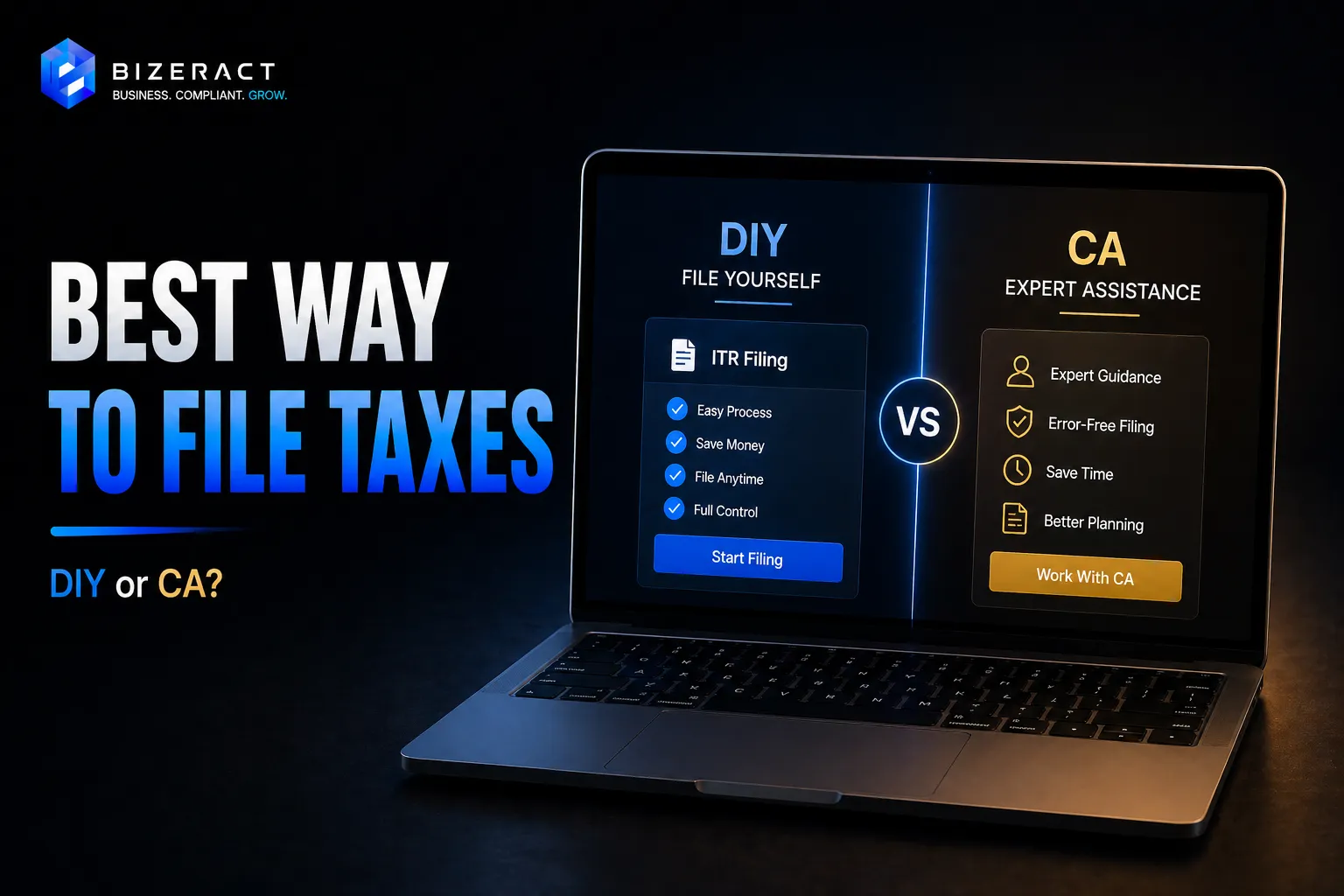
The best way to file taxes in India for FY 2025-26 depends entirely on your income profile. For 70% of salaried Indians with single-source income, filing free on incometax.gov.in takes 25 minutes and costs ₹0. For freelancers with multiple clients and TDS reconciliation needs, paid platforms like ClearTax (₹500–₹4,000) or Tax2Win save 2–3 hours of manual entry. For business owners with capital gains, F&O income, or foreign assets, a local CA (₹2,000–₹15,000) still earns their fee through correct form selection and audit-ready documentation. This guide compares six real filing methods - with actual cost, time, and accuracy data - so you pick the one that matches your situation, not the marketing.
Method 1: Government portal (incometax.gov.in) - Free
The official Income Tax Department portal is the only free option - and 43.82% of FY 2024-25 returns were filed directly on it without any intermediary (CBDT, Aug 2024). Pre-fill auto-pulls salary, TDS, dividend, and FD interest from AIS. ITR-1 takes 25–35 minutes; e-verification with Aadhaar OTP completes in 2 minutes.
- Cost: ₹0
- Time: 25–45 minutes (first-timer); 10–15 minutes (returning filer)
- Best for: Salaried employees with Form 16, freelancers under presumptive (Section 44ADA, ₹50 lakh), pensioners
- Limitations: Manual capital gains entry (each scrip / mutual fund redemption separately), no automated bookkeeping integration, no support beyond static help docs
When the portal works perfectly
Single Form 16 employers, FD interest from one or two banks, and standard 80C/80D deductions are exactly what the portal was built for. The new "Tax regime comparison" feature added in 2024 even computes new vs old regime tax side-by-side - making the toughest filer decision a 2-click choice.
Method 2: ClearTax - ₹500–₹4,000
ClearTax is India's largest paid filing platform, with roughly 9 lakh paid filings annually. Its strength is capital gains aggregation: it auto-imports broker statements from Zerodha, Groww, Upstox, ICICI Direct, and HDFC Securities - saving 1–3 hours of manual scrip-wise entry for active traders.
- Cost: ₹0 for ITR-1 self-file (similar to portal), ₹500 for assisted ITR-1, ₹1,500–₹2,500 for ITR-2 with capital gains, ₹3,000–₹4,000 for ITR-3 with business income
- Time: 15–30 minutes if broker integration works cleanly
- Best for: Equity traders, mutual fund investors with multiple AMCs, salaried employees with side stock income
- Limitations: Add-ons creep (notice management, audit support, CA call) push final cost to ₹3,000+; broker integration occasionally fails for AY's data
Method 3: Tax2Win, Quicko, myITreturn - ₹500–₹3,000
Mid-tier alternatives with similar feature sets to ClearTax but typically ₹200–₹500 cheaper. Quicko (founded 2018) has gained traction with F&O traders for its specialized turnover calculation and tax audit threshold checker. Tax2Win pioneered "free + add-ons" pricing.
- Cost: ₹0–₹500 for basic ITR-1, ₹1,000–₹2,500 for ITR-2/3 with capital gains
- Time: 20–40 minutes
- Best for: Same use cases as ClearTax, with tighter budgets; F&O traders specifically benefit from Quicko's turnover wizard
- Limitations: Smaller broker integration list than ClearTax; customer support response slower during July peak
Method 4: Local CA - ₹500–₹15,000
A local Chartered Accountant remains the right choice for complex situations. CA fees vary wildly by city and complexity - but the accuracy and audit-readiness of CA-filed returns is materially higher than any DIY method.
- ITR-1 (salaried): ₹500–₹2,000 (Tier-2 cities); ₹1,500–₹3,000 (metros)
- ITR-2 (capital gains, multiple house properties): ₹2,000–₹5,000
- ITR-3 (business income): ₹3,000–₹10,000 without audit; ₹15,000–₹30,000 with Section 44AB tax audit
- NRI ITR-2 with DTAA claims: ₹5,000–₹12,000
CAs earn their fee in two specific ways: (1) selecting the correct ITR form to avoid Section 139(9) defective return notices, and (2) handling cases where filers either over-claim or under-claim deductions. For salaried filers with single-employer Form 16, CA value-add is minimal. For F&O traders, business owners, and NRI filers, the CA fee typically pays for itself through one avoided notice or one correctly-claimed deduction. Our when-to-hire-a-CA breakdown covers the specific situations where CA help is genuinely needed.
Method 5: TaxBuddy, TaxSpanner, eFilingPro - ₹500–₹2,500
Hybrid platforms - software plus assigned CA review. The user uploads Form 16 and bank statements; a back-office CA prepares and files the return; the user e-verifies. Splits the difference between full DIY and full CA hire.
- Cost: ₹500–₹1,500 for ITR-1; ₹1,500–₹2,500 for ITR-2
- Time: User effort 15 minutes (upload docs); CA prep 24–48 hours
- Best for: Salaried employees who want CA-quality filing without local CA hassle; first-time freelancers needing presumptive scheme advice
- Limitations: Quality varies by which CA on the platform handles your case; turnaround slows during July peak
Method 6: Direct file via TRPS / employer plan - ₹0
Some large employers (TCS, Infosys, Wipro, ICICI Bank, HDFC Bank) provide subsidized CA filing as an employee benefit through their HR portals. Plus the Income Tax Department's TRPS (Tax Return Preparer Scheme) lists certified preparers in your city who file at government-set rates of ₹250–₹1,000 (TRPScheme.com).
- Cost: ₹0 (employer-paid) or ₹250–₹1,000 (TRPS)
- Time: 30–60 minutes (mostly upload + review)
- Best for: Anyone whose employer offers it; budget-conscious salaried filers in Tier-2 cities
- Limitations: TRPS network thinning since 2020; many listed TRPs have stopped accepting new clients
Quick comparison: cost, time, accuracy
| Method | Cost | Time | Accuracy risk | Best for |
|---|---|---|---|---|
| incometax.gov.in (DIY) | ₹0 | 25–45 min | Low (single Form 16); High (capital gains) | Salaried, pensioners |
| ClearTax | ₹500–₹4,000 | 15–30 min | Low–Medium | Equity traders, MF investors |
| Tax2Win / Quicko | ₹500–₹2,500 | 20–40 min | Low–Medium | F&O, mid-budget |
| Local CA | ₹500–₹15,000 | 2–5 days | Lowest | Business, NRI, capital gains |
| TaxBuddy / TaxSpanner | ₹500–₹2,500 | 1–2 days | Low | Salaried wanting hand-off |
| TRPS / employer | ₹0–₹1,000 | 30–60 min | Low | Employer-subsidized |
How to choose by income profile
Salaried with single Form 16 (most common case)
File free on incometax.gov.in. The portal handles Form 16 pre-fill, regime comparison, and Section 87A rebate calculation automatically. Paid platforms add no real value here - they charge ₹500+ to do what the portal does free. Time: 25 minutes.
Salaried with multiple Form 16s (job change during FY)
Still DIY-friendly - the portal pre-fills both employers' data from AIS. The only manual step is reconciling tax computed under each employer's TDS (which double-counts standard deduction) vs total tax on consolidated salary. The portal flags this. Time: 35–45 minutes.
Salaried + equity / mutual fund investments
DIY works if you have under 20 trades - manually enter scrip-wise gains in ITR-2. Above 20 trades, ClearTax or Quicko's broker import saves 1–2 hours. Cost: ₹1,500–₹2,500 vs ₹0 portal, but time saved is real. Both options are accurate when broker statement is clean.
Freelancer / consultant with presumptive income
DIY using ITR-4 with Section 44ADA presumptive scheme works for receipts up to ₹50 lakh - no books required. Above ₹50 lakh, switch to ITR-3 with full P&L; at this point a CA review (₹2,000–₹5,000) catches expense classification errors that easily save more than the fee.
F&O trader
Use Quicko or hire a CA. F&O income is non-speculative business income requiring ITR-3 with full turnover calculation under Section 44AB rules. Tax audit kicks in at ₹10 crore turnover (revised threshold). Mistakes here are expensive - wrong turnover calculation has triggered Section 271B penalty cases of ₹1.5 lakh.
Business owner with audit (turnover above ₹1 crore / receipts above ₹50 lakh)
Hire a CA. Tax audit under Section 44AB requires CA sign-off on Form 3CD - there's no DIY option. Fees: ₹15,000–₹40,000 depending on book complexity. Filing deadline is October 31, 2026 (vs July 31 for non-audit cases).
NRI with India income
Hire a CA familiar with DTAA. NRIs file ITR-2 (or ITR-3 if business income) - DIY portals generally don't optimize DTAA claims, costing the NRI 5–25% extra tax. CA fee ₹5,000–₹12,000 typically saves 3–10x in correctly-claimed treaty relief.
Foreign assets / Black Money Act compliance
Always hire a CA. Schedule FA non-disclosure carries ₹10 lakh penalty per asset under the Black Money Act 2015 - plus criminal prosecution risk. CA fee for proper Schedule FA filing ₹5,000–₹15,000 is insurance against the worst-case penalty.
What about AI-based tax filing tools?
Several startups launched AI-assisted tax filing in 2024–25 (TaxGenius, Smartax, Refund.ai), promising automated form selection and notice response. As of FY 2025-26, these tools are practically thin wrappers over the same Government portal API used by ClearTax - the "AI" layer adds limited value over rule-based logic. Useful for first-time filers needing plain-English explanations; not yet differentiated for complex returns.
Frequently asked questions
Is ClearTax free?
ClearTax offers a free tier for ITR-1 self-file - but the same return is free on incometax.gov.in. ClearTax's paid tiers (₹500–₹4,000) add broker integration, capital gains aggregation, expert review, and post-filing notice support. For ITR-1 with single Form 16, free portal filing is identical in outcome.
How much does a CA charge to file ITR in India?
Typical fees: ₹500–₹2,000 for ITR-1 in Tier-2 cities; ₹1,500–₹3,000 in metros. ITR-2 with capital gains: ₹2,000–₹5,000. ITR-3 business with audit: ₹15,000–₹30,000. NRI returns with DTAA: ₹5,000–₹12,000. Quote varies by complexity, not just form type.
Should I use the portal or an app like ClearTax?
Use the portal for free if your income is salary + bank interest + simple dividends. Use ClearTax/Quicko if you have 20+ equity trades, multiple mutual fund redemptions, or F&O income - broker import alone saves 1–3 hours. For business income, hire a CA.
Is filing on incometax.gov.in safe?
Yes - it's the official Government of India portal operated by the Income Tax Department. SSL-secured, multi-factor authentication via Aadhaar OTP, no third-party access. Third-party apps (ClearTax, Tax2Win) ultimately submit to the same portal via API - they don't bypass the government system.
What happens if I make a mistake while DIY filing?
File a revised return under Section 139(5) any time before December 31, 2026 (for FY 2025-26). Revised returns replace the original - no penalty for revising a timely-filed return. After December 31, only ITR-U is available with 25–70% additional tax penalty.
Can I switch from CA to DIY filing next year?
Yes - ITR filing is annual; there's no commitment. Many salaried filers use a CA for the first 2–3 years, then switch to DIY once they understand their income pattern. The portal stores previous returns for reference.
The honest verdict: most salaried Indians don't need ClearTax, Tax2Win, or a CA - the government portal handles 95% of routine returns free. Paid platforms earn their fee for complex capital gains, F&O income, or business returns where time savings or accuracy are material. CAs earn theirs for audit-required returns, NRI DTAA claims, and foreign asset compliance - situations where one error costs more than years of CA fees combined. If you're unsure where your situation falls, our DIY vs CA decision guide walks through the exact triggers that flip the answer. Salaried first-timers can start with our step-by-step online ITR guide. Either way, before you start, reconcile your TDS using our Form 26AS / AIS / TIS checker - it prevents 90% of refund delays. For complex situations needing direct help, a quick tax consultation is the fastest way to a clean filing.
What to verify before acting on Best Way to File Taxes in India
Rules and platform behaviour change after an article is published. Confirm forms, due dates, AIS or Form 26AS data, regime rules, and filing instructions against the Income Tax Portal before you act on anything below, because the right answer depends on your entity, state, turnover, and current setup.
Going deeper: Business ITR Filing, ITR Filing (Salaried), and TDS Return Filing.
Frequently asked questions
What is the short answer on Best Way to File Taxes in India?
Portal DIY: ₹0. ClearTax/Tax2win: ₹500–₹4,000. Local CA: ₹500–₹10,000. Real comparison of speed, accuracy, and cost across 6 filing methods - picked by income profile. The practical next step is to compare the article checklist with your business model, state, turnover, documents, and tools before you act.
What should I verify before using this guide?
Verify the latest thresholds, filing dates, forms, documents, and portal guidance from the official source links on this page. Tax rules, ad platform policies, software APIs, marketplace requirements, and search documentation can change after publication.
When should I get professional help?
Get help when the decision affects GST registration, tax filing, paid media budget, production website performance, analytics accuracy, or business-critical automations. A short expert review usually costs less than penalties, rework, bad data, or failed implementation.
Let's talk about your business.
Tell us what you're working on and where you want to go. We'll put together a plan. No obligation, no sales pitch.
- Free 30-minute call
- A plan built around your goals
- No obligation, no pressure
- Your own account manager