Who Is Eligible for GST Registration in India? (2026 Guide)
Threshold limits, voluntary registration, all 4 types of GST, and who can - or must - get a GSTIN. Plain answers for Indian founders and small business owners.
- There are two thresholds - ₹40 lakh for goods, ₹20 lakh for services - not one universal limit.
- Any individual or business can register voluntarily at ₹0 turnover.
- E-commerce sellers on Amazon or Flipkart must register from their first rupee of sales - no threshold applies (Section 24, CGST Act).
- 78% of MSMEs now view GST registration favorably, up from 66% in 2023 (Deloitte GST@7 Survey, 2024).
- GST taxpayer base grew 127% from 2017 to 2025 - from 66.5 lakh to over 1.51 crore (PIB, 2025).
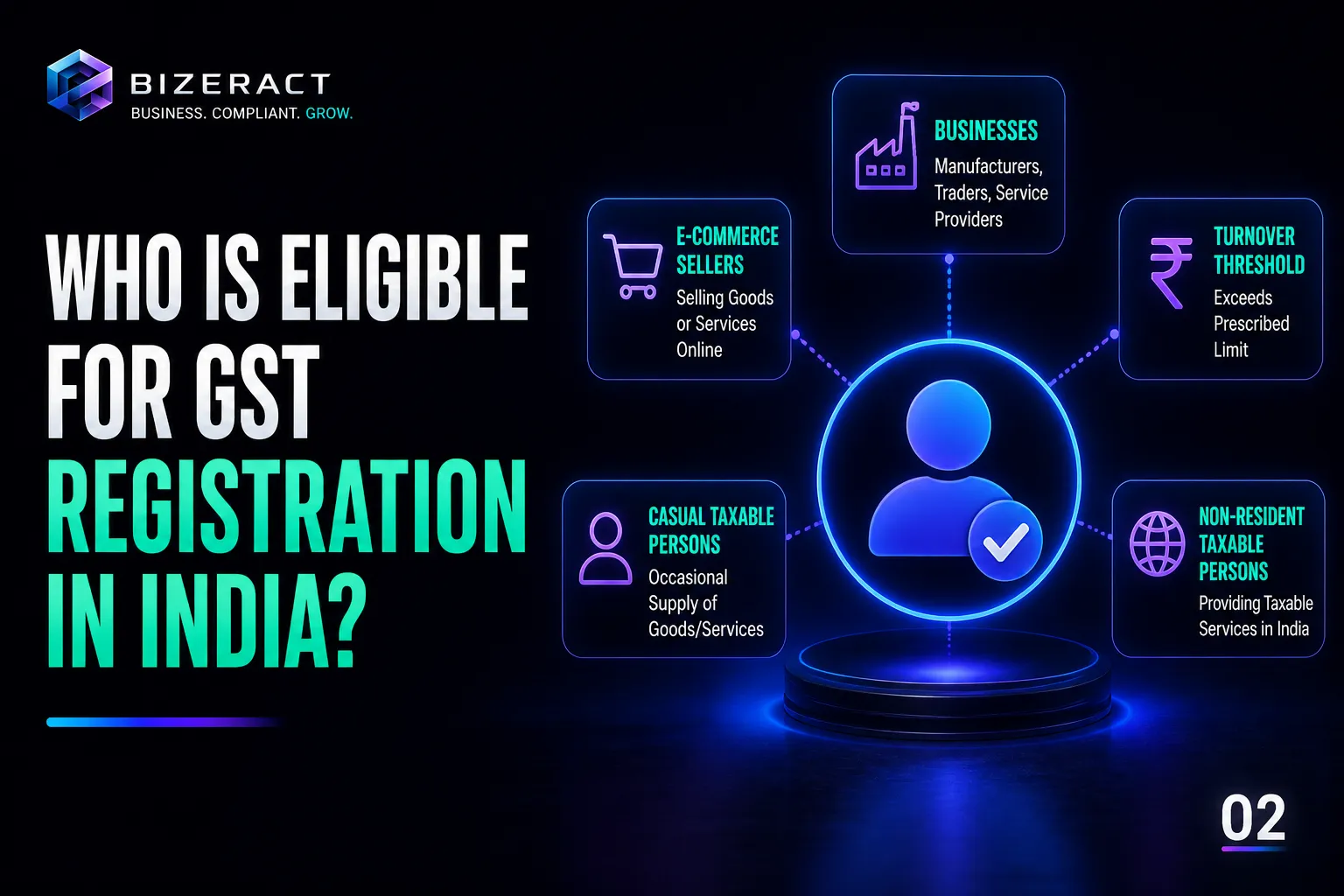
India crossed 1.52 crore active GST registrations in April 2025 - comprising 1.32 crore normal taxpayers, 14.86 lakh composition taxpayers, and 3.71 lakh TDS accounts (Press Information Bureau, 2025). Behind that number are millions of small businesses navigating one deceptively simple question: are they actually required to register, or just eligible to? The answer determines whether you face a ₹10,000 penalty - or leave Input Tax Credit money unclaimed for years.
Eligible vs mandatory: why the distinction matters
India's GST taxpayer base has grown 127% since July 2017 - from 66.5 lakh to over 1.51 crore by April 2025 (PIB, 2025). Much of that growth came from voluntary registrations, not just threshold breaches. The word "eligible" means the government will accept your application. "Mandatory" means you have no choice - and penalties apply if you delay.
Any Indian individual or business entity - sole proprietor, partnership firm, LLP, private limited company, trust, or HUF - is eligible to register. The government doesn't screen applicants on business size or age. What changes is whether registration is legally required, which depends on your turnover, the nature of your supply, and how you sell.
What are the 4 types of GST in India?
GST is not a single tax - it's split into four components determined by where the transaction occurs. Understanding this matters when you file returns, because you collect and remit different components depending on your buyer's location.
| Type | Applies when | Rate split (18% example) | Revenue goes to |
|---|---|---|---|
| CGST | Intra-state sale (seller and buyer in same state) | 9% | Central Government |
| SGST | Intra-state sale | 9% | State Government |
| IGST | Inter-state sale or import | Full 18% | Central Govt (then apportioned) |
| UTGST | Sale within a Union Territory without legislature | 9% | Union Territory |
For most small businesses selling within their home state, you'll deal with CGST + SGST only. The moment you ship to a buyer in another state, you switch to IGST - which is why inter-state sellers must register regardless of their turnover.
What is the GST income limit - ₹20 lakh or ₹40 lakh?
The ₹40 lakh threshold was introduced on April 1, 2019 (32nd GST Council meeting, PIB notification March 7, 2019) and applies specifically to suppliers of goods in most Indian states. Services businesses retained the original ₹20 lakh limit. The confusion is common - and it costs people.
- ₹40 lakh/year - pure goods suppliers in most states (introduced April 2019)
- ₹20 lakh/year - service providers in most states; goods suppliers in Manipur, Mizoram, Nagaland, Tripura
- ₹10 lakh/year - service providers in special category states
The limit applies to aggregate turnover - your combined revenue across all GSTINs, all business verticals, all states. A ₹35 lakh retailer who also charges ₹5,000/month for delivery isn't a "pure goods supplier" - the mixed supply brings them under the ₹20 lakh services limit for their entire turnover.
Who is not required to register for GST?
Despite 1.52 crore registrations, a large number of Indian businesses legitimately sit outside the mandatory net. You're not required to register if you meet all of the following:
- Your aggregate annual turnover is below the applicable threshold
- You make no inter-state taxable supplies
- You don't sell through any e-commerce platform
- You're not liable under reverse charge mechanism
- You deal exclusively in GST-exempt goods or services (basic food items, unprocessed produce, healthcare, educational services)
Agriculturists supplying their own produce are also specifically excluded from mandatory registration under Section 23 of the CGST Act, regardless of the value of their produce.
Is everyone eligible for GST? Can a normal person get a GST number?
Yes - the GST portal accepts applications from any person carrying out any economic activity. A freelance graphic designer, a home baker selling on Instagram, a retired professional doing consulting - all are eligible to voluntarily register even below the threshold. You need a PAN, an Aadhaar linked to an active mobile number, and a bank account. A home address works as the principal place of business for proprietorships.
Three practical reasons below-threshold individuals voluntarily register:
- Corporate clients won't buy without a GSTIN. Most companies above ₹5 crore turnover require vendor GSTINs to claim Input Tax Credit. Without your GSTIN, they simply move to the next vendor.
- You can claim ITC on your own purchases. If you buy a laptop, software subscriptions, or office equipment for your business, registered status lets you reclaim the 18% GST paid on those inputs - effectively cutting your costs.
- E-commerce platforms require it. Amazon, Flipkart, Meesho, and every major Indian marketplace mandate GSTIN before your first listing. TCS rules under Section 52 apply from the first rupee of sales (effective since 2017, TCS rate reduced to 0.5% from July 2024).
How to qualify for GST registration: the 5 triggers
There is no application score or assessment. Registration becomes mandatory the moment any one of these conditions is met - and voluntary registration is open to everyone else:
- Aggregate turnover in a financial year exceeds your applicable threshold (₹10L / ₹20L / ₹40L)
- You make any inter-state taxable supply - even a single invoice to a buyer in another state
- You sell through any e-commerce platform (Amazon, Flipkart, Meesho, Swiggy, Zomato)
- You are liable to pay tax under reverse charge mechanism (Section 9(3) or 9(4))
- You choose to register voluntarily for ITC, credibility, or client requirements
Once mandatory registration is triggered, you have 30 days to apply from the date you became liable. Applications filed after that window attract a minimum ₹10,000 penalty under Section 122 of the CGST Act.
New applicants should also choose the right registration route. Low-liability B2B applicants can review the GST Rule 14A fast-track registration route, while risk-flagged applicants should prepare for GST biometric Aadhaar authentication. If your first sales channel is Blinkit, Zepto, or Instamart, use the quick-commerce seller GST checklist before onboarding.
Frequently asked questions on GST eligibility
Is GST registration limit ₹2.5 lakh?
No - ₹2.5 lakh is not a GST registration threshold. The limits are ₹40 lakh (goods, most states), ₹20 lakh (services, most states), and ₹10 lakh (services, special category states). The ₹2.5 lakh figure sometimes appears in income tax exemption discussions, not GST.
Can I file GST without a CA?
Yes. The GST portal (gst.gov.in) is open to self-filers and charges no government fee for either registration or return filing. Most straightforward proprietorship registrations can be completed in 2-3 hours with clean documents. CA involvement becomes valuable when Aadhaar authentication fails, when officer queries (SCNs) are raised, or when the business structure is complex.
What happens if I cross the threshold but don't register?
You owe GST on all taxable supplies made from the date you became liable - retroactively. Penalty under Section 122: 10% of tax due, minimum ₹10,000. If non-registration is found to be intentional, the penalty rises to 100% of tax due. Your buyers also lose ITC rights on all purchases made from you during the unregistered period.
Can a salaried person get GST registration?
A salaried person who also runs a business or provides freelance services can register for GST on that business income. Salary itself is not a "supply" under GST and doesn't count toward the threshold. If your freelance income crosses ₹20 lakh, or if your corporate clients require a GSTIN, registration applies to the business activity - not your employment.
If you've hit the threshold or need a GSTIN for a client or marketplace, our GST registration service delivers your GSTIN in 24 hours - documents to certificate. For pre-revenue teams needing a GSTIN before their first invoice, see GST registration for startups. If you're unsure whether your turnover qualifies, our GST registration for small businesses page walks through the threshold calculation with examples.
What to verify before acting on Who Is Eligible for GST Registration in India
Rules and platform behaviour change after an article is published. Confirm thresholds, registration status, return forms, document rules, and portal notices against the GST Portal before you act on anything below, because the right answer depends on your entity, state, turnover, and current setup.
| Checkpoint | Why it matters | Where to confirm |
|---|---|---|
| Current rule or platform status | Limits, forms, policies, and APIs can change after a blog update. | GST Portal |
| Your exact business case | A local shop, freelancer, D2C store, agency, and SaaS team rarely need the same next step. | Documents, invoices, campaign data, analytics setup, or workflow logs |
| Implementation evidence | The safest GST decision is backed by proof, not memory or screenshots from an old setup. | Portal acknowledgement, dashboard export, invoice sample, test lead, or error log |
Going deeper: GST Registration, GST Registration for Small Business, and GST Registration for Startups.
Frequently asked questions
What is the GST registration threshold in India?
The GST registration threshold is ₹40 lakh annual turnover for goods suppliers in most states, ₹20 lakh for service providers in most states, and ₹10 lakh for service providers in special category states (Manipur, Mizoram, Nagaland, Tripura, and other NE states).
Can any person get a GST number voluntarily?
Yes. Any individual or business carrying out an economic activity is eligible to register for GST voluntarily, regardless of turnover. Voluntary registration requires a PAN, an Aadhaar linked to an active mobile number, and a bank account.
Is GST registration limit ₹2.5 lakh?
No. ₹2.5 lakh is an income tax exemption limit, not a GST threshold. GST thresholds are ₹40 lakh for goods, ₹20 lakh for services, and ₹10 lakh for services in special category states.
Do e-commerce sellers need GST registration regardless of turnover?
Yes. Under Section 24(ix) of the CGST Act, suppliers selling through e-commerce platforms like Amazon, Flipkart, or Meesho must register for GST before their first sale, regardless of annual turnover.
Can a salaried person get GST registration?
A salaried person who also runs a business or provides freelance services can register for GST on that business income. Salary itself is not a supply under GST and does not count toward the registration threshold.
What is the penalty for not registering despite being eligible?
If you become mandatory for GST registration and do not register within 30 days, the penalty is 10% of tax due with a minimum of ₹10,000 under Section 122 of the CGST Act. Deliberate non-compliance can attract penalties up to ₹1 lakh under Section 74A (effective FY 2024-25).
Let's talk about your business.
Tell us what you're working on and where you want to go. We'll put together a plan. No obligation, no sales pitch.
- Free 30-minute call
- A plan built around your goals
- No obligation, no pressure
- Your own account manager