Who Needs to Register for GST in India? Mandatory vs Voluntary (2026)
Which businesses must register for GST, which are exempt, and what happens if you collect GST without a GSTIN. Covers inter-state sales, e-commerce, and service thresholds.
- Which businesses must register for GST, which are exempt, and what happens if you collect GST without a GSTIN. Covers inter-state sales, e-commerce, and service thresholds.
- Use this as a gst registration checklist for who needs to register for gst in india, not as a substitute for checking current official or platform rules.
- Confirm thresholds, filing dates, forms, documents, and portal guidance against the source links before filing, buying software, changing campaigns, or changing a workflow.
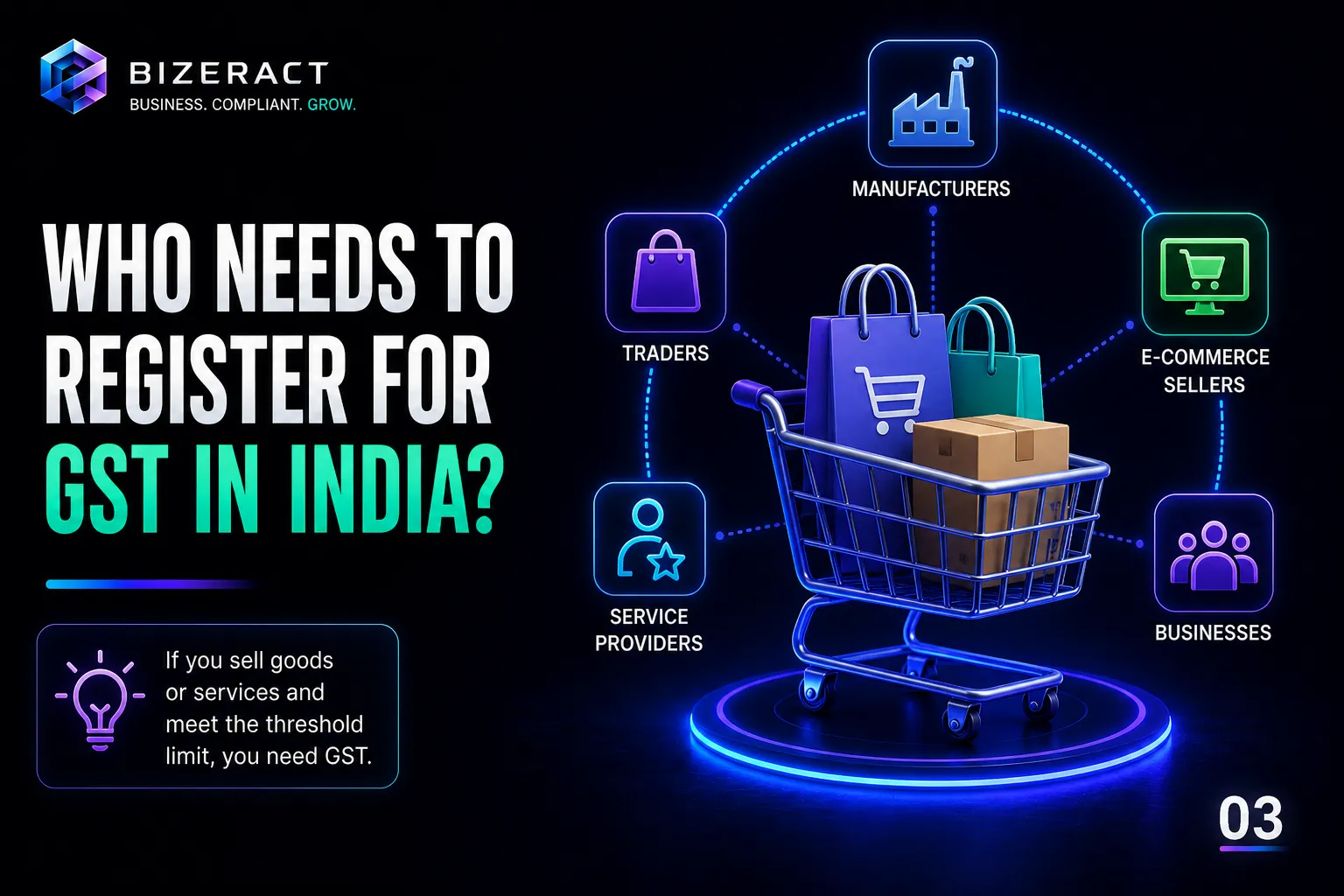
India's GST taxpayer base grew 127% in eight years - from 66.5 lakh registered businesses in July 2017 to over 1.51 crore by April 2025 (PIB, 2025). That growth came from two forces: threshold breaches and smart voluntary registrations. If you're asking whether you need to register, the answer depends on exactly which of eight legal triggers applies to your situation - not just your annual revenue.
- Mandatory registration has 8 triggers - crossing the turnover threshold is just one of them.
- Inter-state sales trigger mandatory registration from the first rupee, regardless of annual turnover.
- E-commerce sellers on Amazon, Flipkart, Meesho must register before their first sale - Section 24(ix), CGST Act.
- Operating above-threshold without registering: penalty of 10% of tax due, minimum ₹10,000 (Section 122).
- New Section 74A (effective FY 2024-25): tighter enforcement with penalties up to ₹1 lakh for deliberate non-compliance (CBIC, 2025).
Who is mandatory to register for GST? The 8 triggers
Under Sections 22 and 24 of the CGST Act, 2017, any one of the following conditions makes GST registration mandatory - no exemptions, no grace period beyond 30 days from the trigger date:
- Aggregate turnover exceeds threshold: ₹40 lakh/year for goods (most states), ₹20 lakh/year for services, ₹10 lakh for services in special category states.
- Any inter-state taxable supply: A single invoice to a customer in another state triggers mandatory registration - regardless of annual revenue.
- E-commerce operator: If you operate a marketplace where other sellers transact, mandatory registration applies.
- Selling through e-commerce platforms: Amazon, Flipkart, Meesho, Swiggy, Zomato sellers must register before their first sale. TCS at 0.5% applies from July 2024 (reduced from 1%).
- Reverse charge mechanism (RCM): If you're required to pay GST as a recipient under Section 9(3) - for example, buying legal services from an advocate - registration is mandatory regardless of turnover.
- Input Service Distributor (ISD): Companies distributing ITC credits from a head office to branches across states.
- Casual taxable person: Businesses operating temporarily in a state where they're not normally registered - trade fair stalls, project-based work in another state.
- Non-resident taxable person: Foreign businesses making taxable supplies in India must register before commencing supply.
Is GST compulsory for small businesses below the threshold?
Below the threshold and selling only within your home state and not on any marketplace - GST is not compulsory. But the threshold trap catches many small businesses that don't realise they've mixed supply types.
If you provide any service alongside your goods - installation, delivery, warranty support, consulting - you're no longer a pure goods supplier. Your entire aggregate turnover then falls under the ₹20 lakh services limit, not the ₹40 lakh goods limit. We've seen this catch hardware shops, furniture sellers, and IT equipment retailers who bundled setup services without knowing the classification implications.
The top 5 states by GST registrations - Uttar Pradesh (13.2%), Maharashtra (12.1%), Gujarat (8.4%), Tamil Nadu (7.7%), Karnataka (6.9%) - account for roughly 50% of India's active taxpayer base (SBI Research, GST 8-Year Report, 2025). Compliance rates differ significantly by state.
Which companies need to charge GST on invoices?
Every GST-registered business making a taxable supply must charge GST on the invoice - at the rate applicable to the HSN/SAC code of the goods or service supplied. If you're registered and issue an invoice without GST on a taxable supply, the liability doesn't disappear. You still owe the tax out of pocket, with no legal recourse to collect it from the customer retroactively.
Businesses dealing exclusively in exempt supplies don't charge GST but also can't claim Input Tax Credit on inputs. Common exempt categories: unprocessed food items, milk, fresh vegetables, healthcare services, educational services up to higher secondary level, and RBI-regulated financial services.
Do I have to pay GST if I'm not registered?
If you've crossed the mandatory threshold and aren't registered, you owe GST on every taxable supply made from the date you became liable - retrospectively. This is where the cost compounds.
Under Section 122 of the CGST Act: penalty = 10% of tax due, minimum ₹10,000. Under the new Section 74A framework effective FY 2024-25, deliberate non-compliance attracts penalties of ₹1 lakh or 10% of tax - whichever is higher (CBIC Circular, 2025).
The less obvious cost: your buyers lose ITC on all purchases from you during the unregistered period. When they discover this in their own GST audit, they'll demand a refund of the GST component or simply stop buying from you. For B2B businesses, this is often more financially damaging than the direct statutory penalty.
What is the minimum income to register for GST voluntarily?
There is no minimum. Voluntary registration is open to any business at ₹0 turnover. The government actively encourages below-threshold businesses to register - 78% of MSMEs now view GST favorably, up from 66% in 2023 (Deloitte GST@7 Survey, 2024), largely because ITC benefits and formal market access have proved tangible over eight years of the system.
Voluntary registrations can be cancelled after a minimum of one year. This gives small businesses a trial option if compliance overhead outweighs benefits - though most who register voluntarily keep their GSTIN once they start winning B2B contracts that require it.
Who will approve my GST registration - and how long does it take?
A jurisdictional GST officer (Central or State) processes your application. Since November 1, 2025, low-risk applicants using Aadhaar authentication with monthly output tax liability ≤ ₹2.5 lakh qualify for 3-working-day fast-track approval under Rule 14A (CBIC, 2025). Standard Aadhaar-authenticated applications are approved within 7 working days per CBIC Instruction 03/2025-GST. Without Aadhaar authentication, the timeline extends to 30 working days.
If the officer raises a Show Cause Notice (SCN), you have 7 working days to respond. An unanswered SCN results in rejection - requiring a fresh application and losing the original submission date, which matters when you're counting days against the 30-day mandatory registration window.
Frequently asked questions
Who is not required to register for GST?
Businesses below the applicable threshold that sell only within their home state, don't sell on any e-commerce platform, and aren't subject to reverse charge - these have no mandatory obligation. Agriculturists supplying their own farm produce are also specifically exempt under Section 23, regardless of the value supplied.
How does the ₹40 lakh limit apply if I sell both goods and services?
Mixed supply businesses are treated as service providers for threshold purposes. If your goods shop (₹30L) also charges for installation services (₹5L), your aggregate is ₹35L - and the ₹20L services limit applies to the combined figure. You became liable at ₹20L total, not ₹40L.
What if I'm mandatory to register but can't afford compliance costs?
The Composition Scheme under Section 10 lets eligible businesses (turnover below ₹1.5 crore for goods, ₹50 lakh for services) pay a flat tax rate of 1–5% instead of full GST - with no input tax credit and simplified quarterly filing. Compliance cost drops to roughly ₹1,500–₹3,000/year in professional fees for most small businesses on the scheme.
For same-day filing with SCN response included, our GST registration for small businesses covers the process end-to-end. Also see: full GST registration overview and GST for proprietorships.
What should you verify before using this GST Registration guide?
Before acting on who needs to register for gst in india, verify the current rules or platform behavior with the GST Portal. The practical answer depends on your business model, state, turnover, documents, software stack, and whether the decision affects tax, customer data, paid media spend, or a production workflow.
Use this article as a working checklist, then confirm thresholds, registration status, return forms, document rules, and portal notices. In our audits, most expensive mistakes do not come from ignoring the whole process. They come from one stale assumption, one mismatched address, one missing event, or one automation path that nobody tested after launch.
| Checkpoint | Why it matters | Where to confirm |
|---|---|---|
| Current rule or platform status | Limits, forms, policies, and APIs can change after a blog update. | GST Portal |
| Your exact business case | A local shop, freelancer, D2C store, agency, and SaaS team rarely need the same next step. | Documents, invoices, campaign data, analytics setup, or workflow logs |
| Implementation evidence | The safest GST decision is backed by proof, not memory or screenshots from an old setup. | Portal acknowledgement, dashboard export, invoice sample, test lead, or error log |
How do we apply this in real business work?
We start with the smallest decision that can be verified. For compliance work, that means matching PAN, address, bank, invoices, and portal status before filing. For websites, marketing, analytics, and automation, it means testing the real user path from first click to final record. The boring checks catch the costly failures.
A useful rule: if a claim changes money, tax, reporting, or customer communication, keep evidence for it. Save the acknowledgement, export the report, test the form, and note the date you verified the source. That gives you a clean trail when a client, officer, platform, or internal team asks why the setup was done that way.
When should you get expert review?
Get expert review when the next action can create tax exposure, lost reporting data, ad waste, broken customer communication, or production downtime. A simple self-check is enough for low-risk learning. A filed return, new registration, tracking migration, paid campaign restructure, or live automation deserves a second set of eyes before it affects customers or records.
How often should this be rechecked?
Recheck the decision whenever your turnover, state, product mix, campaign budget, website stack, analytics property, or workflow ownership changes. Also recheck it after major portal updates, platform policy changes, annual filing deadlines, and vendor migrations. The guide is useful today only if the facts behind it still match your business.
What is the fastest safe way to decide?
Write the decision in one sentence, list the proof needed for that sentence, and verify only those items first. This keeps the work focused. If the proof confirms the decision, proceed. If one item is unclear, pause and resolve that point before changing filings, campaigns, tracking, website code, or automation logic.
What can go wrong if you skip verification?
The usual failure is not dramatic at first. It looks like a rejected application, a wrong tax invoice, a missing conversion, a duplicate lead, a broken report, or a workflow that silently stops. Those small failures become expensive when nobody notices them until month-end reporting, filing day, or a customer escalation.
What evidence should you keep after making the change?
Keep enough evidence to reconstruct the decision later. For a compliance topic, that usually means the application reference number, registration certificate, invoice sample, return acknowledgement, payment challan, notice reply, or source link checked on the day of filing. For a website, campaign, analytics setup, or automation, keep the before-and-after screenshot, test submission, dashboard export, webhook log, and the exact setting that changed.
This matters because most business fixes are revisited months later, when nobody remembers the original reason. A short evidence trail makes audits faster, handovers cleaner, and vendor conversations more precise. It also keeps the advice in this guide tied to your real operating context instead of becoming a generic checklist that gets copied without review.
- Date checked: record when the official source, dashboard, or portal screen was reviewed.
- Business context: note the entity, state, product, campaign, property, or workflow affected.
- Proof of action: save the acknowledgement, report export, test result, or live URL.
- Owner: assign one person to re-check the item when rules, tools, or business volume change.
Which next step should you take after reading this?
Turn the article into one action list. Mark what is already true, what needs proof, and what needs expert review. If you want to go deeper, compare this guide with GST Registration, GST Registration for Small Business, and GST Registration for Proprietorship. Then update the decision only after the official source and your own records agree.
Frequently asked questions
What is the mandatory GST registration threshold turnover in India?
Mandatory GST registration threshold is ₹40 lakh annual turnover for goods businesses in most states, ₹20 lakh for service providers in most states, and ₹10 lakh for service providers in special category states. Once any trigger is met, registration must be completed within 30 days.
Who is not required to register for GST in India?
Businesses below the applicable threshold that sell only within their home state, do not sell on any e-commerce platform, and are not subject to reverse charge are not required to register. Agriculturists supplying their own farm produce are also specifically exempt under Section 23 of the CGST Act, regardless of the value supplied.
Do interstate sellers need GST registration from the first rupee?
Yes. Under Section 24 of the CGST Act, any business making inter-state taxable supplies must register for GST regardless of annual turnover. Even a single invoice to a buyer in another state triggers mandatory registration.
What happens if I run a business above the GST threshold without registering?
If you cross the mandatory GST threshold without registering, you owe GST on all taxable supplies made from the date you became liable — retrospectively. Penalty under Section 122 is 10% of tax due, minimum ₹10,000. Your buyers also lose ITC on all purchases made from you during the unregistered period.
What is the Composition Scheme and who can use it?
The Composition Scheme under Section 10 lets eligible businesses with turnover below ₹1.5 crore (goods) or ₹50 lakh (services) pay a flat tax rate of 1-5% instead of full GST, with no input tax credit and simplified quarterly filing. Compliance cost is significantly lower under the scheme.
Let's talk about your business.
Tell us what you're working on and where you want to go. We'll put together a plan. No obligation, no sales pitch.
- Free 30-minute call
- A plan built around your goals
- No obligation, no pressure
- Your own account manager