GST Composition Scheme: Who Should Opt In (and Who Shouldn't)
Composition scheme lets small businesses pay 1-6% GST and file quarterly, but blocks ITC and interstate sales. See when it fits in 2026 with examples.
- The composition scheme trades tax rate for capability: a low flat rate on turnover and quarterly filing, in exchange for no GST on invoices, no ITC, and no interstate sales.
- Eligibility caps at ₹1.5 crore turnover for goods dealers (₹75 lakh in certain NE states), with a separate 6% scheme for service providers up to ₹50 lakh. Restaurants qualify only if they do not serve alcohol.
- Composition taxpayers file CMP-08 quarterly and GSTR-4 annually, not GSTR-1 and GSTR-3B. Crossing ₹1.5 crore mid-year forces an auto-exit with back taxes.
- It suits a single-state, local, B2C shop whose customers never ask for ITC, and it traps anyone planning interstate sales, marketplace listings, or B2B clients who need credit.
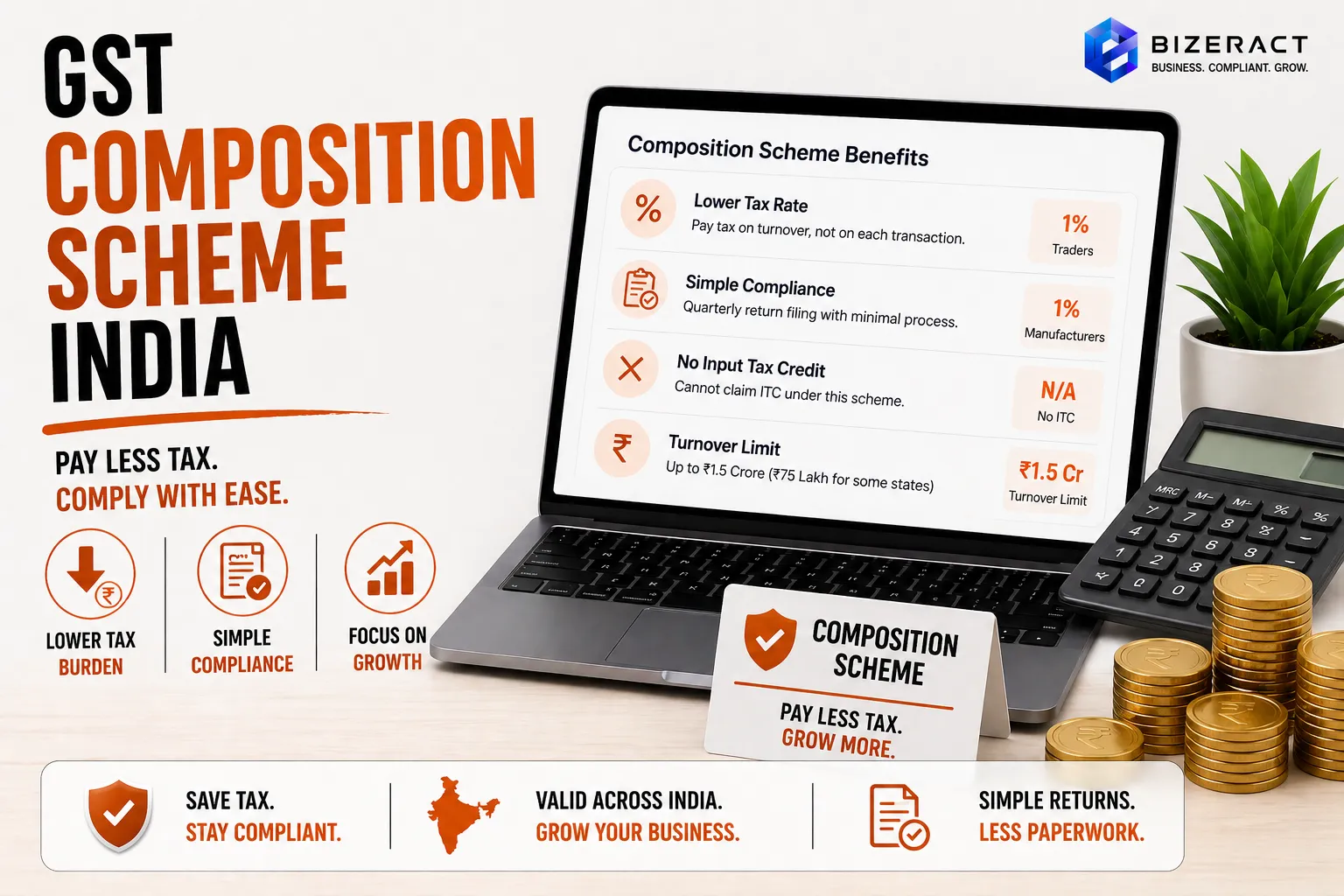
The GST composition scheme promises small business owners the simplest possible GST life - 1% tax, quarterly filing, almost no paperwork. For the right business, it's a gift. For the wrong one, it locks you out of ITC, e-commerce, and interstate sales.
This guide explains the GST composition scheme in 2026 - who qualifies, who should opt in, and who should run the other way.
What is the GST composition scheme?
The composition scheme lets eligible small businesses pay GST at a low flat rate on turnover and file returns quarterly, instead of monthly. You cannot charge GST on your invoices, cannot claim ITC, and cannot sell across state borders.
Who is eligible?
- Turnover up to ₹1.5 crore (₹75 lakh in certain NE states)
- Dealers in goods (not interstate)
- Restaurants not serving alcohol
- Service providers up to ₹50 lakh turnover (separate scheme)
Who is NOT eligible?
- Inter-state suppliers
- E-commerce sellers on Amazon, Flipkart, Meesho
- Manufacturers of ice cream, pan masala, tobacco
- Casual and non-resident taxable persons
- Suppliers of non-taxable goods
Composition scheme GST rates
- Manufacturers: 1% (0.5% CGST + 0.5% SGST)
- Traders: 1%
- Restaurants (no alcohol): 5%
- Service providers under special scheme: 6%
Benefits of opting in
- Simplified quarterly return (CMP-08)
- Low flat tax - easy cash flow
- Minimal compliance - one annual return (GSTR-4)
- Fewer records to maintain
- Great for cash-heavy local businesses
Drawbacks (and why many should avoid)
- No ITC on purchases - you pay full tax on inputs
- Cannot collect GST from customers
- Cannot sell interstate
- Cannot sell on e-commerce marketplaces
- B2B buyers avoid you - they can't claim ITC
Step-by-step: opt into the composition scheme
- Log in to the GST portal
- Services → Registration → Application to opt for composition levy
- File Form CMP-02 at the start of the financial year (or within 30 days of registration)
- Declare opening stock in Form ITC-03 (reverse ITC on existing stock)
- Start charging composition rate from the effective date
- File CMP-08 quarterly; GSTR-4 annually
Documents required
- Existing GST registration certificate
- Turnover declaration for the preceding year
- Stock statement as on effective date
- List of inputs on which ITC was claimed
Cost of composition scheme
- Government fee: ₹0
- Filing costs: ₹200–₹500 per quarter via CA
- Opportunity cost: lost ITC, lost B2B clients
Compare regular registration via our GST registration for small business page.
Common mistakes with composition
- Opting in despite interstate sales - disqualifies instantly
- Charging GST on invoices - composition dealers cannot
- Not reversing ITC on opening stock - triggers demand
- Missing the annual GSTR-4 - late fees accrue
- Crossing ₹1.5 Cr mid-year - auto-exit with back taxes
Frequently Asked Questions
Is composition scheme good for small shops?
Yes if they sell within one state, cash or local B2C only, and don't need ITC. See GST for shop owners.
Can freelancers opt for composition?
Service providers have a separate 6% scheme up to ₹50 lakh. See GST for freelancers.
Can I switch from composition to regular?
Yes, file CMP-04 during the financial year or automatically when turnover exceeds ₹1.5 Cr.
Do I need to file GSTR-1 under composition?
No. Composition taxpayers file CMP-08 quarterly and GSTR-4 annually.
Can composition dealers claim input tax credit?
No. That is the primary drawback.
Is composition scheme available for Pvt Ltd?
Yes if they meet turnover and activity conditions - but rarely the best choice for companies.
What if I accidentally issue a tax invoice?
You may be reclassified to regular with retrospective tax + interest. Use "Bill of Supply" instead of "Tax Invoice".
What should you do next?
Composition scheme is a powerful simplification for small, local, B2C businesses - and a trap for anyone who wants to grow beyond one state or claim ITC. Run the numbers before opting in.
Get GST registration in 24 hours with expert support. Our CA team recommends composition only if it truly benefits you. Start with GST registration or read GST for traders.
What to verify before acting on GST Composition Scheme
Rules and platform behaviour change after an article is published. Confirm thresholds, registration status, return forms, document rules, and portal notices against the GST Portal before you act on anything below, because the right answer depends on your entity, state, turnover, and current setup.
Going deeper: Composition Scheme, GST Registration for Small Business, and GST Registration for Small Business.
Frequently asked questions
What is the short answer on GST Composition Scheme?
Composition scheme lets small businesses pay 1-6% GST and file quarterly, but blocks ITC and interstate sales. See when it fits in 2026 with examples. The practical next step is to compare the article checklist with your business model, state, turnover, documents, and tools before you act.
What should I verify before using this guide?
Verify the latest thresholds, filing dates, forms, documents, and portal guidance from the official source links on this page. Tax rules, ad platform policies, software APIs, marketplace requirements, and search documentation can change after publication.
When should I get professional help?
Get help when the decision affects GST registration, tax filing, paid media budget, production website performance, analytics accuracy, or business-critical automations. A short expert review usually costs less than penalties, rework, bad data, or failed implementation.
Let's talk about your business.
Tell us what you're working on and where you want to go. We'll put together a plan. No obligation, no sales pitch.
- Free 30-minute call
- A plan built around your goals
- No obligation, no pressure
- Your own account manager