HSN Code Finder Guide: How to Pick the Right HSN/SAC for Your Business
Find the right HSN or SAC code before GST filing. Avoid blocked ITC, invoice mismatch, and notices with this practical HSN lookup guide for 2026.
- Wrong HSN or SAC classification can create invoice mismatch, blocked ITC, notices, and wrong tax-rate application.
- Use product or service description, GST rate schedules, invoices, and industry practice before finalising a code.
- Review HSN/SAC whenever products, service bundles, or tax-rate notifications change.
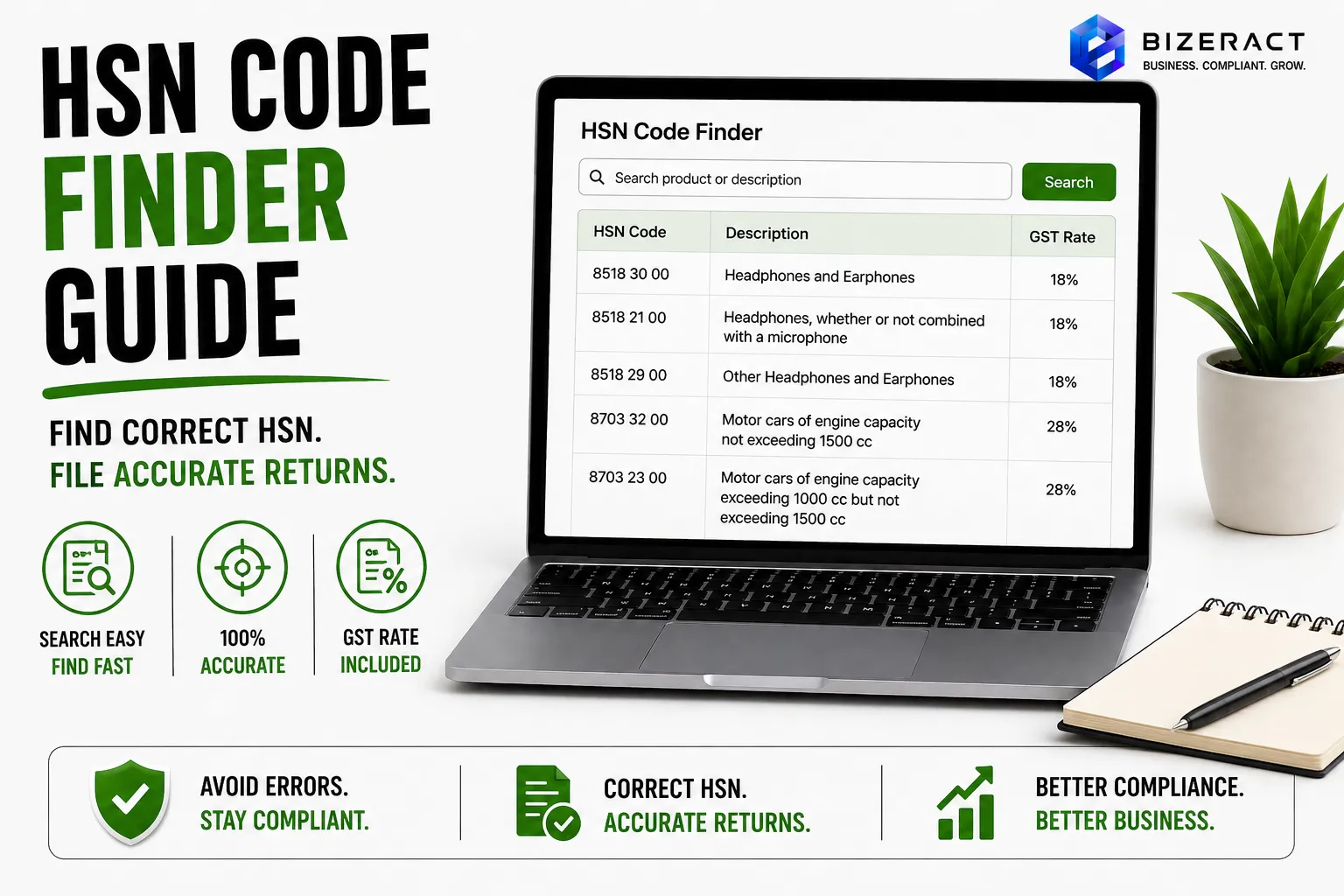
HSN and SAC codes are the classification system GST uses to tag every product and service. Pick the wrong code on your first invoice and you will be untangling Show Cause Notices for months. Pick the right one and your registration, returns, and ITC all flow cleanly.
This guide explains how to find the right HSN code (for goods) and SAC code (for services), with a simple lookup process and the mistakes small businesses make most often.
What are HSN and SAC codes?
HSN (Harmonized System of Nomenclature) is a globally standardised code system for goods, developed by the World Customs Organization. India uses 4, 6, and 8-digit variants depending on turnover.
SAC (Service Accounting Code) is India's 6-digit code system for services. Every service sold under GST gets tagged with a SAC.
Who needs to use HSN/SAC codes?
- Every GST-registered business
- E-commerce sellers uploading product catalogues
- Freelancers and consultants issuing service invoices
- Manufacturers declaring products at customs
- Traders filing GSTR-1 summaries
Benefits of picking the right HSN/SAC
- Correct GST rate applied - no under/overcharging
- ITC claimed cleanly without reversal
- GSTR-1 uploads accepted first time
- Zero officer queries during registration
- E-way bills generate without error
HSN digits required by turnover
- Up to ₹5 crore turnover: 4-digit HSN on B2B invoices (optional on B2C)
- Above ₹5 crore turnover: 6-digit HSN mandatory on all invoices
- Exports/imports: 8-digit HSN always
Step-by-step: find the right HSN code
- List your products clearly - by common category name and material
- Visit the CBIC HSN directory - cbic-gst.gov.in → HSN search
- Search by keyword or description
- Narrow by chapter - HSN is organised into 99 chapters
- Match the 4-digit heading, then drill to 6 or 8 digits
- Verify the GST rate against the CGST schedule
- Lock it into your inventory system - never look it up again
Step-by-step: find the right SAC code
- Identify the service category - IT, consulting, repair, transport, etc.
- Visit the GST portal SAC directory
- Match against Chapter 99 - all SACs start with 99
- Pick the 6-digit SAC that matches your activity
- Confirm the applicable GST rate (usually 18%)
Common HSN/SAC codes for popular businesses
- Software services - 998314
- Digital marketing - 998361
- Management consulting - 998311
- Ready-made garments - 6109, 6110
- Mobile phones - 8517
- Footwear under ₹1,000 - 6401
- Restaurant services - 996331
- Freight transport by road - 996791
Cost of wrong HSN selection
- Show Cause Notice - adds 7+ days to registration
- ITC reversal - immediate cash cost
- Penalty up to ₹25,000 per incorrect invoice
- Interest on tax shortfall - 18% per annum
Compare our GST registration for traders and GST registration for e-commerce for category-specific HSN help.
Common mistakes
- Using a generic "miscellaneous" code - always rejected
- Mixing HSN and SAC - services use SAC, goods use HSN
- Copy-pasting from a competitor - their business activity may differ
- Ignoring 8-digit requirement for exports
- Not updating on rate revisions - HSN rates change with every council meeting
Frequently Asked Questions
Is HSN mandatory on all invoices?
Yes for B2B. Optional on B2C up to ₹5 crore turnover, but best practice to include it anyway.
What if my product fits two HSN codes?
Pick the more specific one. Generic codes invite audit queries.
Can I change my HSN later?
Yes. Update in GSTR-1 from the next return; amend the GST registration if the main activity changes.
Is SAC 998314 always 18%?
Most software services are 18%, but export of software is zero-rated with LUT filing.
Where do I find GST rates for each HSN?
CBIC publishes rate schedules. Cross-check every HSN against the current rate notification.
Does freelance work need an HSN or SAC?
Services use SAC. See GST registration for freelancers.
What happens at audit if HSN is wrong?
Officer reclassifies, recovers differential tax, and levies a penalty. Always document your choice.
What should you do next?
Getting HSN/SAC right once - and locking it into your invoicing system - prevents 90% of the classification disputes Indian businesses face. Spend 30 minutes at registration, not 30 days in notices later.
Get GST registration in 24 hours with expert support. Our CA team maps your activity to the correct HSN/SAC before submission. Start with GST registration or read the documents checklist.
What to verify before acting on HSN Code Finder Guide
Rules and platform behaviour change after an article is published. Confirm thresholds, registration status, return forms, document rules, and portal notices against the GST Portal before you act on anything below, because the right answer depends on your entity, state, turnover, and current setup.
Going deeper: GST Registration, GST Registration for Small Business, and GST Registration for E-commerce.
Frequently asked questions
What is the short answer on HSN Code Finder Guide?
Find the right HSN or SAC code before GST filing. Avoid blocked ITC, invoice mismatch, and notices with this practical HSN lookup guide for 2026. The practical next step is to compare the article checklist with your business model, state, turnover, documents, and tools before you act.
What should I verify before using this guide?
Verify the latest thresholds, filing dates, forms, documents, and portal guidance from the official source links on this page. Tax rules, ad platform policies, software APIs, marketplace requirements, and search documentation can change after publication.
When should I get professional help?
Get help when the decision affects GST registration, tax filing, paid media budget, production website performance, analytics accuracy, or business-critical automations. A short expert review usually costs less than penalties, rework, bad data, or failed implementation.
Let's talk about your business.
Tell us what you're working on and where you want to go. We'll put together a plan. No obligation, no sales pitch.
- Free 30-minute call
- A plan built around your goals
- No obligation, no pressure
- Your own account manager