Input Tax Credit (ITC) Rules in GST: Full Guide for 2026
Use GST input tax credit correctly with eligibility checks, blocked credits, GSTR-2B reconciliation, vendor risk, and ITC reversal safeguards in 2026.
- ITC eligibility depends on valid invoices, supplier reporting, business use, receipt of goods or services, and timely return filing.
- Blocked credits under Section 17(5), GSTR-2B mismatch, and unpaid vendor invoices are common ITC reversal triggers.
- Monthly ITC reconciliation is safer than waiting for year-end corrections.
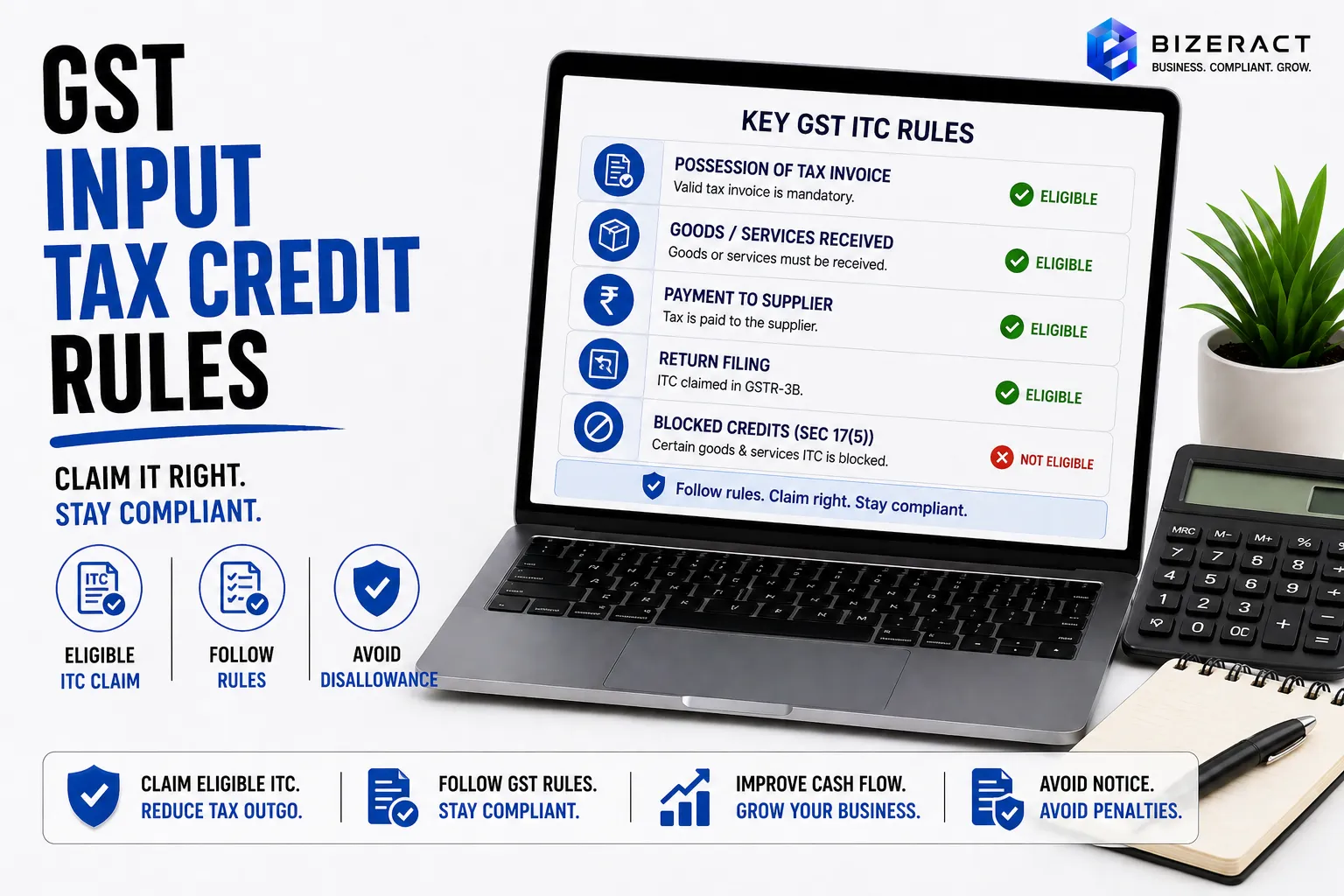
Input Tax Credit is the reason GST works - without it, every supply chain would get taxed twice. But ITC is also the number one audit target. One missed reconciliation, one late invoice, one non-filing supplier, and your claim goes to zero.
This guide covers ITC rules in 2026 - what qualifies, what's blocked, and the one process that protects your ITC permanently.
What is Input Tax Credit?
ITC is the credit of GST paid on purchases that you offset against GST collected on sales. If you paid ₹18,000 on inputs and collected ₹30,000 on sales, your net tax liability is only ₹12,000.
Who can claim ITC?
- Every GST-registered taxpayer, except composition dealers
- Businesses making taxable supplies
- Exporters (with LUT / refund)
- Service providers registered under regular scheme
Benefits of claiming ITC correctly
- Reduce effective tax cost
- Improve working capital
- Stay competitive on pricing
- Clean audit trail
- Faster refunds on exports
Conditions for claiming ITC (Section 16)
- You must possess a valid tax invoice
- Goods or services must have been received
- Supplier must have filed GSTR-1 and paid tax
- You must file your GSTR-3B return
- Payment to supplier must be made within 180 days
Blocked credits (Section 17(5))
- Motor vehicles (with exceptions)
- Food, beverages, outdoor catering
- Membership of clubs and health centres
- Life and health insurance (personal)
- Travel benefits to employees on vacation
- Goods lost, stolen, destroyed, written off
- Construction of immovable property for own use
Step-by-step: ITC reconciliation process
- Download GSTR-2B - auto-drafted from supplier GSTR-1
- Match against purchase register - invoice-by-invoice
- Flag mismatches - missing, extra, or different values
- Chase non-filing suppliers - ITC blocked until they file
- Claim only matched ITC - in GSTR-3B Table 4
- Follow up next cycle - unclaimed ITC rolls forward 180 days
Documents to maintain
- All purchase tax invoices
- Bill of supply (for composition vendors)
- Debit and credit notes
- Payment proofs within 180 days
- GSTR-2B downloads (month-wise)
- Reconciliation worksheets
Cost of losing ITC
- Direct cash loss equal to the denied credit
- 18% interest from the date of wrong claim
- Penalty up to 100% in fraud cases
- Supplier relationship damage
Common mistakes with ITC
- Claiming ITC before supplier files GSTR-1 - auto-reversed
- Missing 180-day payment rule - ITC reversed with interest
- Claiming blocked credits - demand notice
- Not reconciling monthly - errors snowball
- Ignoring GSTR-2B - system-generated, legally binding
- Claiming ITC on personal expenses - common in small business
- Double claiming - same invoice across periods
Frequently Asked Questions
Can I claim ITC on a cancelled GSTIN's invoice?
No. Always verify supplier status before claiming.
What is the time limit to claim ITC?
Up to November 30 of the following financial year, or filing of the annual return, whichever is earlier.
Does ITC apply to capital goods?
Yes, in the same month of purchase (not spread over life of asset).
Can I claim ITC on advance payment?
No. ITC is claimed only when the actual invoice is issued and goods/services received.
What is the 180-day rule?
Payment to the supplier must be made within 180 days of invoice. Otherwise ITC is reversed with interest.
Can freelancers claim ITC on laptops and software?
Yes, if used for business. See GST for freelancers.
Is ITC available on export supplies?
Yes - exports are zero-rated. Claim refund on accumulated ITC via RFD-01.
What should you do next?
ITC is too important to leave to a year-end cleanup. Build a monthly reconciliation habit and your claims will stay bulletproof through any audit.
Get GST registration in 24 hours with expert support - our first-month filing sets up your ITC hygiene correctly. Start with GST registration or read GST return filing guide.
What should you verify before using this GST Filing guide?
Before acting on input tax credit rules in gst, verify the current rules or platform behavior with the GST Portal. The practical answer depends on your business model, state, turnover, documents, software stack, and whether the decision affects tax, customer data, paid media spend, or a production workflow.
Use this article as a working checklist, then confirm thresholds, registration status, return forms, document rules, and portal notices. In our audits, most expensive mistakes do not come from ignoring the whole process. They come from one stale assumption, one mismatched address, one missing event, or one automation path that nobody tested after launch.
| Checkpoint | Why it matters | Where to confirm |
|---|---|---|
| Current rule or platform status | Limits, forms, policies, and APIs can change after a blog update. | GST Portal |
| Your exact business case | A local shop, freelancer, D2C store, agency, and SaaS team rarely need the same next step. | Documents, invoices, campaign data, analytics setup, or workflow logs |
| Implementation evidence | The safest GST decision is backed by proof, not memory or screenshots from an old setup. | Portal acknowledgement, dashboard export, invoice sample, test lead, or error log |
How do we apply this in real business work?
We start with the smallest decision that can be verified. For compliance work, that means matching PAN, address, bank, invoices, and portal status before filing. For websites, marketing, analytics, and automation, it means testing the real user path from first click to final record. The boring checks catch the costly failures.
A useful rule: if a claim changes money, tax, reporting, or customer communication, keep evidence for it. Save the acknowledgement, export the report, test the form, and note the date you verified the source. That gives you a clean trail when a client, officer, platform, or internal team asks why the setup was done that way.
When should you get expert review?
Get expert review when the next action can create tax exposure, lost reporting data, ad waste, broken customer communication, or production downtime. A simple self-check is enough for low-risk learning. A filed return, new registration, tracking migration, paid campaign restructure, or live automation deserves a second set of eyes before it affects customers or records.
How often should this be rechecked?
Recheck the decision whenever your turnover, state, product mix, campaign budget, website stack, analytics property, or workflow ownership changes. Also recheck it after major portal updates, platform policy changes, annual filing deadlines, and vendor migrations. The guide is useful today only if the facts behind it still match your business.
What is the fastest safe way to decide?
Write the decision in one sentence, list the proof needed for that sentence, and verify only those items first. This keeps the work focused. If the proof confirms the decision, proceed. If one item is unclear, pause and resolve that point before changing filings, campaigns, tracking, website code, or automation logic.
What can go wrong if you skip verification?
The usual failure is not dramatic at first. It looks like a rejected application, a wrong tax invoice, a missing conversion, a duplicate lead, a broken report, or a workflow that silently stops. Those small failures become expensive when nobody notices them until month-end reporting, filing day, or a customer escalation.
What evidence should you keep after making the change?
Keep enough evidence to reconstruct the decision later. For a compliance topic, that usually means the application reference number, registration certificate, invoice sample, return acknowledgement, payment challan, notice reply, or source link checked on the day of filing. For a website, campaign, analytics setup, or automation, keep the before-and-after screenshot, test submission, dashboard export, webhook log, and the exact setting that changed.
This matters because most business fixes are revisited months later, when nobody remembers the original reason. A short evidence trail makes audits faster, handovers cleaner, and vendor conversations more precise. It also keeps the advice in this guide tied to your real operating context instead of becoming a generic checklist that gets copied without review.
- Date checked: record when the official source, dashboard, or portal screen was reviewed.
- Business context: note the entity, state, product, campaign, property, or workflow affected.
- Proof of action: save the acknowledgement, report export, test result, or live URL.
- Owner: assign one person to re-check the item when rules, tools, or business volume change.
Which next step should you take after reading this?
Turn the article into one action list. Mark what is already true, what needs proof, and what needs expert review. If you want to go deeper, compare this guide with GST Registration, GST Registration for Small Business, and GST Registration for Small Business. Then update the decision only after the official source and your own records agree.
Frequently asked questions
What is the short answer on Input Tax Credit Rules in GST?
Use GST input tax credit correctly with eligibility checks, blocked credits, GSTR-2B reconciliation, vendor risk, and ITC reversal safeguards in 2026. The practical next step is to compare the article checklist with your business model, state, turnover, documents, and tools before you act.
What should I verify before using this guide?
Verify the latest thresholds, filing dates, forms, documents, and portal guidance from the official source links on this page. Tax rules, ad platform policies, software APIs, marketplace requirements, and search documentation can change after publication.
When should I get professional help?
Get help when the decision affects GST registration, tax filing, paid media budget, production website performance, analytics accuracy, or business-critical automations. A short expert review usually costs less than penalties, rework, bad data, or failed implementation.
Let's talk about your business.
Tell us what you're working on and where you want to go. We'll put together a plan. No obligation, no sales pitch.
- Free 30-minute call
- A plan built around your goals
- No obligation, no pressure
- Your own account manager