GST Reverse Charge Mechanism (RCM): A Plain-English Guide
Understand GST reverse charge: when buyers pay GST, which services are covered, how ITC works, and mistakes that trigger notices in 2026 filing today.
- Reverse charge shifts GST payment responsibility from supplier to recipient for notified goods, services, and supplier categories.
- RCM entries must be paid in cash first; eligible ITC can usually be claimed only after the tax is paid correctly.
- Track RCM separately in books so vendor bills, payment vouchers, and GSTR-3B reporting do not get missed.
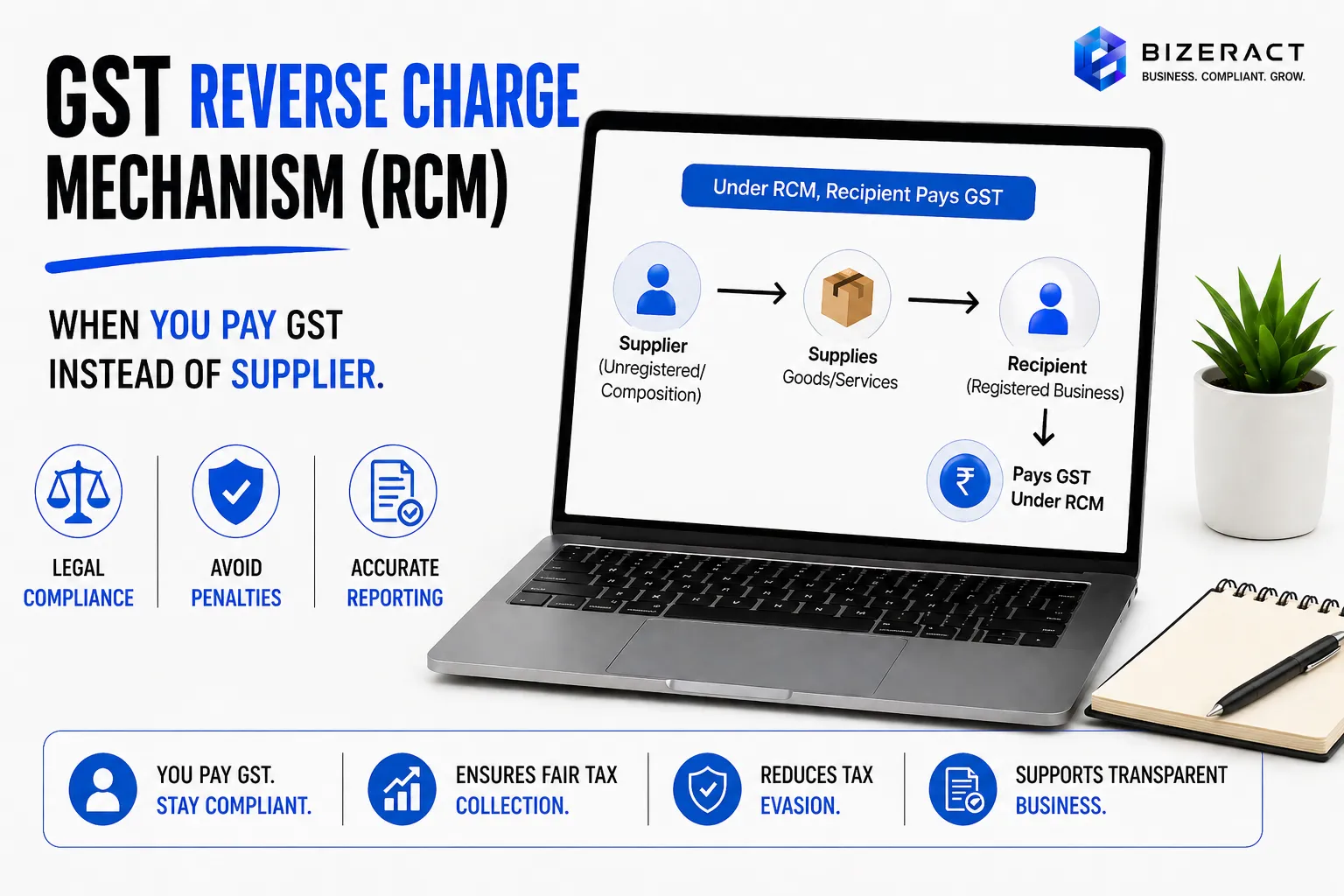
Reverse Charge Mechanism (RCM) flips the normal GST flow - instead of the seller paying tax, the buyer pays. Miss it on a single transaction and you owe back-tax, interest, and late fees. Get it right and your ITC stays clean.
This guide explains GST RCM in plain English - when it applies, who pays, how to claim ITC, and the mistakes that bring in notices.
What is Reverse Charge Mechanism in GST?
Under RCM, the recipient of goods or services pays GST directly to the government, instead of the supplier collecting and paying it. You then claim ITC on the same tax, provided conditions are met.
RCM is governed by Section 9(3) and 9(4) of the CGST Act.
Who pays tax under RCM?
- The recipient - regardless of the supplier's GST status
- The recipient must be registered under GST
- Tax is paid in cash - cannot be offset against existing ITC
Services covered under RCM
- Goods transport agency (GTA) services to registered persons
- Legal services by advocates
- Director's remuneration to companies
- Services by government or local authority
- Sponsorship services
- Import of services
- Renting of motor vehicles to corporate recipients
Benefits of understanding RCM
- Avoid tax recovery during audits
- Claim ITC correctly - no reversal risk
- Handle legal and GTA invoices cleanly
- Protect yourself when dealing with unregistered suppliers
Step-by-step: comply with RCM
- Identify RCM-liable transaction - match against CBIC notifications
- Self-invoice - generate an invoice under your own GSTIN
- Pay tax in cash - via PMT-06 challan
- Report in GSTR-3B - Table 3.1(d) + Table 4(A)(3)
- Claim ITC in next cycle - subject to Section 16 conditions
- Maintain records - invoice, payment voucher, challan
Documents to maintain
- Self-invoice under RCM
- Payment voucher
- PMT-06 challan
- GTA consignment note
- Advocate's bill of supply
Cost of missing RCM
- 18% annual interest on unpaid tax
- Penalty up to 100% of tax amount
- ITC denial on underlying input
- Audit escalation
Common mistakes under RCM
- Offsetting RCM tax with existing ITC - must be paid in cash
- Missing self-invoice - audit flag
- Skipping GTA invoices - most common miss
- Not tracking director sitting fees - falls under RCM
- Forgetting foreign software imports - always RCM
Frequently Asked Questions
Is RCM applicable to all businesses?
Only to registered GST taxpayers. Unregistered persons don't pay RCM.
Can I claim ITC on RCM tax paid?
Yes - in the same or later month, subject to Section 16 conditions.
Do freelancers need to worry about RCM?
If they hire advocates, use GTA, or import software subscriptions - yes. See GST for freelancers.
Is RCM applicable on rent paid to landlords?
Only for commercial rent to registered persons from unregistered owners under specific notifications. Residential rent is generally exempt.
What is self-invoicing?
The buyer issues an invoice on behalf of the seller for RCM transactions. Must carry all standard invoice fields.
Can RCM tax be paid via ITC ledger?
No. RCM must be paid in cash through the electronic cash ledger.
Is import of services always RCM?
Yes, when the recipient is in India and registered. Foreign SaaS, consulting, and licensing fall under RCM.
What should you do next?
RCM is where small businesses quietly bleed compliance money. Identify your RCM-liable transactions once, build a monthly checklist, and you'll never face a notice on them again.
Get GST registration in 24 hours with expert support - plus your first month's RCM-ready GSTR-3B filing included. Start with GST registration or read GST for consultants.
What to verify before acting on GST Reverse Charge Mechanism
Rules and platform behaviour change after an article is published. Confirm thresholds, registration status, return forms, document rules, and portal notices against the GST Portal before you act on anything below, because the right answer depends on your entity, state, turnover, and current setup.
Going deeper: GST Registration, GST Registration for Small Business, and GST Registration for Freelancers.
Frequently asked questions
What is the short answer on GST Reverse Charge Mechanism?
Understand GST reverse charge: when buyers pay GST, which services are covered, how ITC works, and mistakes that trigger notices in 2026 filing today. The practical next step is to compare the article checklist with your business model, state, turnover, documents, and tools before you act.
What should I verify before using this guide?
Verify the latest thresholds, filing dates, forms, documents, and portal guidance from the official source links on this page. Tax rules, ad platform policies, software APIs, marketplace requirements, and search documentation can change after publication.
When should I get professional help?
Get help when the decision affects GST registration, tax filing, paid media budget, production website performance, analytics accuracy, or business-critical automations. A short expert review usually costs less than penalties, rework, bad data, or failed implementation.
Let's talk about your business.
Tell us what you're working on and where you want to go. We'll put together a plan. No obligation, no sales pitch.
- Free 30-minute call
- A plan built around your goals
- No obligation, no pressure
- Your own account manager