GST Registration Limit: 20 Lakh or 40 Lakh? Plus Documents & Why It's Required
The 20 vs 40 lakh GST threshold explained - which applies to your business, what documents you need to file, and why GST registration is legally required above the limit.
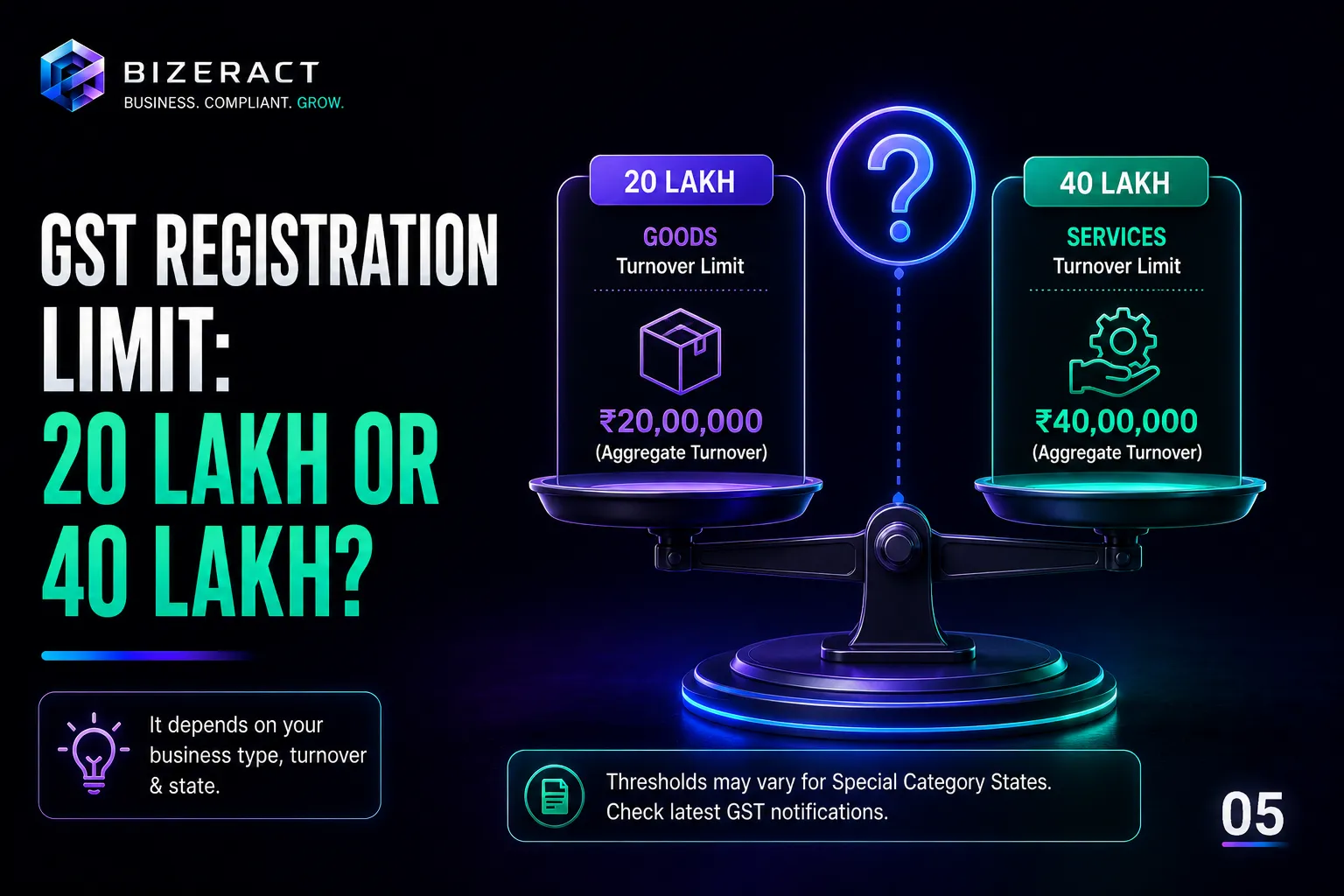
- The ₹40 lakh threshold applies only to pure goods suppliers in most states - introduced April 1, 2019.
- Services businesses and mixed suppliers: ₹20 lakh threshold still applies (retained from 2017).
- GST now contributes approximately 27.9% of India's total tax revenue - ₹22.08 lakh crore in FY 2024-25 (PIB, 2025).
- 1.50 crore informal micro enterprises registered on Udyam Assist Platform still operate without a GSTIN (PIB, 2024).
- Documents required differ by entity type - proprietorships need 5 documents; companies need 7+ including DSC.
India has over 63 million MSMEs (Ministry of MSME, 2024) - but only 1.51 crore active GST registrations (PIB, April 2025). That gap exists partly because millions of small businesses don't know which threshold applies to them, what documents they need, or why registration is legally required. This post answers all three.
Is the GST registration limit 20 lakhs or 40 lakhs?
Both figures are correct - they apply to different business types. The GST Council introduced the ₹40 lakh threshold on April 1, 2019 (PIB notification, March 7, 2019) specifically for suppliers of goods in most Indian states. The original ₹20 lakh threshold from 2017 remains in force for service providers and businesses making mixed supplies.
| Business type | Most states threshold | Special category states* |
|---|---|---|
| Pure goods supplier | ₹40 lakh/year | ₹20 lakh/year |
| Service provider | ₹20 lakh/year | ₹10 lakh/year |
| Mixed goods + services | ₹20 lakh/year | ₹10 lakh/year |
*Special category states with lower thresholds: Manipur, Mizoram, Nagaland, Tripura, and Union Territories of J&K, Himachal Pradesh, and Uttarakhand opted for the ₹20 lakh goods threshold instead of ₹40 lakh.
The trap that catches most business owners: if you sell goods and also charge for any service - delivery, installation, warranty, consulting - you're classified as a mixed supplier. Your entire aggregate turnover then falls under the ₹20 lakh limit, not ₹40 lakh. A furniture shop doing ₹38 lakh in sales but also charging ₹2 lakh for installation services crossed the ₹20 lakh limit long before they crossed ₹40 lakh.
Why is GST registration required by law?
GST now accounts for approximately 27.9% of India's total tax revenue - ₹22.08 lakh crore collected in FY 2024-25 alone, growing 9.4% year-on-year (PIB, 2025). That scale is only possible because registration is mandatory, not optional, above the threshold. Section 22 of the CGST Act makes it a legal obligation.
Beyond legal compliance, the practical reasons registration matters for your business:
- Tax invoice rights. Only registered businesses can issue a valid tax invoice. Without one, your B2B buyers can't claim Input Tax Credit - so they simply won't purchase from you.
- Inter-state sales unlock. Any sale that crosses a state border requires GST registration, regardless of turnover. A Mumbai manufacturer selling to a Bengaluru buyer triggers mandatory registration from the first invoice.
- E-commerce access. Amazon India, Flipkart, Meesho, and every major Indian marketplace require GSTIN before your first listing - with no turnover threshold exemption.
- ITC on your own purchases. Registered businesses reclaim GST paid on inputs. Unregistered businesses absorb it as a cost - effectively paying 18% more for every business expense.
- Penalty avoidance. Operating above-threshold without registering: minimum ₹10,000 penalty or 10% of tax due under Section 122, CGST Act.
What documents are required for GST registration?
Document requirements vary by business structure. CBIC issued new guidelines in April 2025 (Instruction 03/2025-GST) to streamline document standards and reduce rejection rates. Here's the current checklist:
| Document | Proprietorship | Partnership / LLP | Pvt Ltd / OPC |
|---|---|---|---|
| PAN | Proprietor's personal PAN | Firm PAN | Company PAN |
| Aadhaar | Proprietor's (active mobile linked) | Authorised partner | Authorised director |
| Address proof | Electricity bill <3 months + rent agreement or NOC if rented | Same | Same |
| Bank document | Cancelled cheque or statement with IFSC printed | Same | Same |
| Photo | Proprietor passport-size | All partners | All directors |
| Constitution proof | Not required | Partnership deed | MOA + AOA + incorporation certificate |
| DSC | Not required | Required for LLP | Required for all directors |
The most common rejection reason is an address proof in the landlord's name without an NOC letter. If the electricity bill is in your landlord's name, you need both the bill and a signed NOC from the property owner on plain paper - without it, the officer will raise a Show Cause Notice.
Can a normal person apply - or do you need a company?
Any Indian individual with a PAN and an active Aadhaar-linked mobile number can apply for GST registration. A home address works as the principal place of business for proprietorships - there's no requirement for a separate commercial office.
Notably, 1.50 crore informal micro enterprises registered on the Udyam Assist Platform within 14 months of its launch (PIB, 2024) - demonstrating that sole proprietors and micro-businesses are registering in large numbers, even at very small scale. The barrier isn't eligibility; it's usually document readiness and threshold confusion.
What happens if you miss the registration window?
Once you become liable (threshold crossed, or inter-state sale made), you have 30 days to apply. After that window, the penalty clock starts. You owe GST retroactively from the date you became liable - plus the Section 122 penalty minimum of ₹10,000. Buyers who transacted with you during the unregistered period also lose their ITC claims, which creates a secondary commercial dispute on top of the tax liability.
Frequently asked questions
Is the ₹40 lakh threshold applicable for all states?
No. Manipur, Mizoram, Nagaland, Tripura, and certain Union Territories opted for the ₹20 lakh goods threshold instead of ₹40 lakh. Service providers in all states retain the ₹20 lakh limit regardless. Always check the specific notification for your state if you're near the boundary.
Does the threshold reset every year?
Yes. Aggregate turnover is calculated on a financial year basis (April–March). If your turnover crosses the threshold mid-year, you must register within 30 days of crossing it. In the following year, if turnover stays below the threshold, you can apply for voluntary cancellation - but the registration remains mandatory for the year it was crossed.
Why is GST registration required even for small businesses selling online?
Section 24(ix) of the CGST Act mandates GST registration for all persons supplying goods or services through e-commerce platforms that collect TCS, regardless of turnover. Amazon, Flipkart, and Meesho all collect TCS - so their sellers must register before their first sale. This rule applies even if your annual turnover would be below the ₹20 lakh or ₹40 lakh threshold.
Ready to file? Our online GST registration service delivers your GSTIN in 24 hours - documents to certificate. Also see: full GST registration overview for all entity types and GST for small businesses for a threshold calculator and composition scheme comparison.
What to verify before acting on GST Registration Limit
Rules and platform behaviour change after an article is published. Confirm thresholds, registration status, return forms, document rules, and portal notices against the GST Portal before you act on anything below, because the right answer depends on your entity, state, turnover, and current setup.
Going deeper: GST Registration, GST Registration for Small Business, and GST Registration Online India.
Frequently asked questions
What is the short answer on GST Registration Limit?
The 20 vs 40 lakh GST threshold explained - which applies to your business, what documents you need to file, and why GST registration is legally required above the limit. The practical next step is to compare the article checklist with your business model, state, turnover, documents, and tools before you act.
What should I verify before using this guide?
Verify the latest thresholds, filing dates, forms, documents, and portal guidance from the official source links on this page. Tax rules, ad platform policies, software APIs, marketplace requirements, and search documentation can change after publication.
When should I get professional help?
Get help when the decision affects GST registration, tax filing, paid media budget, production website performance, analytics accuracy, or business-critical automations. A short expert review usually costs less than penalties, rework, bad data, or failed implementation.
Let's talk about your business.
Tell us what you're working on and where you want to go. We'll put together a plan. No obligation, no sales pitch.
- Free 30-minute call
- A plan built around your goals
- No obligation, no pressure
- Your own account manager