GST vs Income Tax: What's the Difference? (Simple Breakdown)
GST and income tax are different: one taxes consumption, one taxes income. See examples, registration triggers, and compliance impact for SMBs today.
- GST is an indirect tax on supply that you collect from customers and pass to the government; income tax is a direct tax on your profit. You pay both, and neither substitutes for the other.
- GST is never part of profit. Income tax is computed on GST-exclusive revenue, so the GST you collected does not inflate your taxable income.
- GST paid on purchases is normally recovered as ITC against GST on sales, not claimed as a business expense — only non-creditable GST, such as blocked credits under Section 17(5), becomes a deductible cost.
- The two hit different business shapes differently: high-turnover, low-margin businesses feel the GST cash-flow squeeze, while high-margin ones feel the income-tax bill.
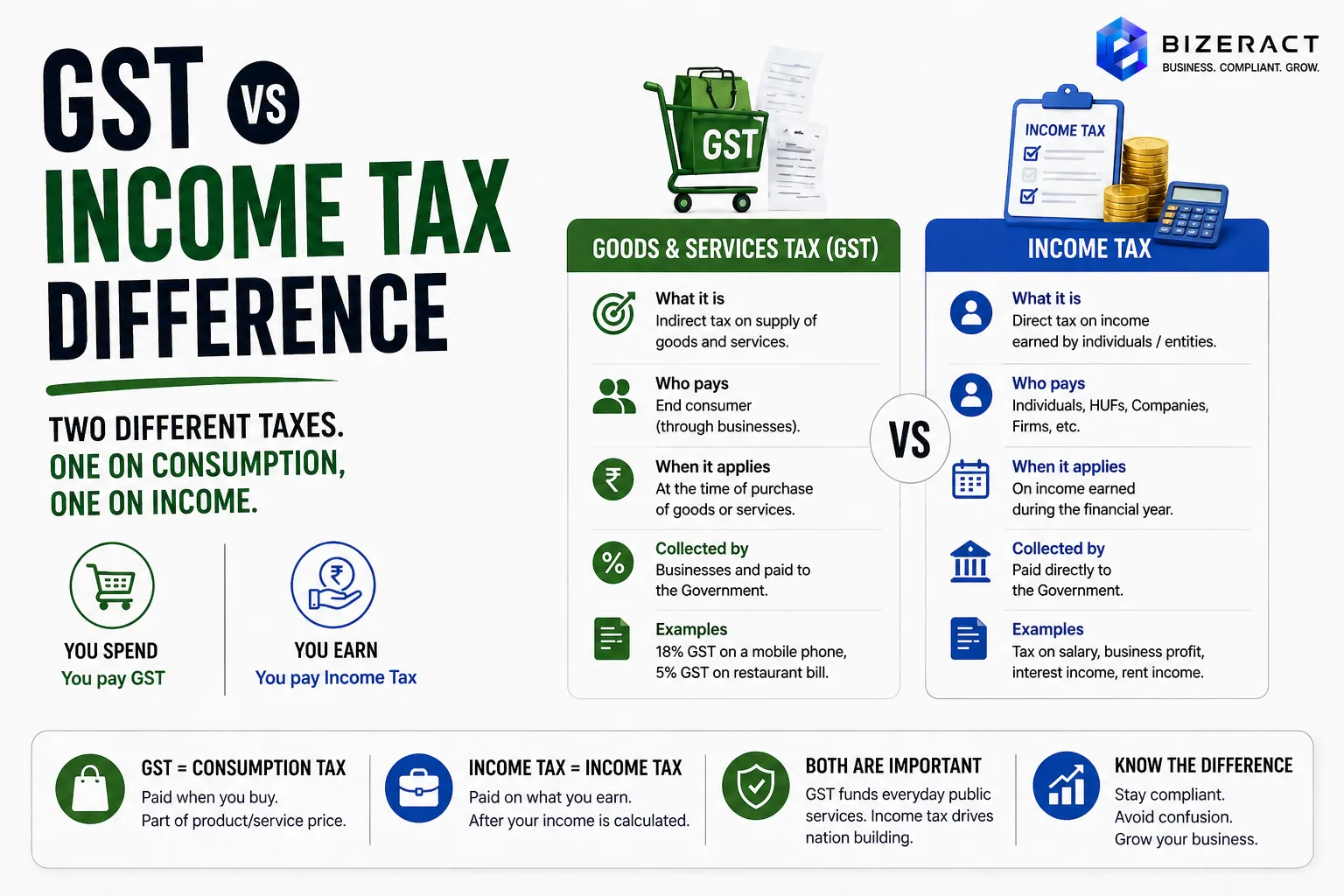
GST and income tax sound similar to most first-time entrepreneurs - both are central taxes, both involve filing, both have deadlines. They are completely different animals. Confuse them and you will over-pay, under-pay, or miss either entirely.
This short guide explains the key differences between GST and income tax for small business owners in India.
Source check: cross-check indirect-tax rules on the official GST portal and direct-tax filing guidance on the Income Tax Department website before making compliance decisions.
What is GST?
Goods and Services Tax is an indirect tax levied on the supply of goods and services. The business collects it from customers and remits it to the government. GST is a tax on consumption.
What is income tax?
Income tax is a direct tax levied on the income you earn. Individuals, Hindu Undivided Families, partnerships, LLPs, and companies all pay income tax at defined slab or flat rates.
Who pays what?
- GST: collected from customer, paid by business to government
- Income tax: paid by the earner directly from their income
Key differences at a glance
- Type: GST indirect, income tax direct
- Base: GST on sales, income tax on profit
- Authority: GST Council / CBIC vs Income Tax Department / CBDT
- Filing frequency: GST monthly/quarterly, income tax annual
- ITC vs deductions: ITC reduces GST paid; deductions reduce taxable income
Benefits of understanding both
- Correct pricing - GST collected is not your revenue
- Clean books - separate ledgers for GST and income tax
- Accurate TDS compliance
- Better cash planning - two different outflow cycles
Filing process: GST vs income tax
GST
- GSTR-1 (outward supply)
- GSTR-3B (summary)
- GSTR-9 (annual)
Income tax
- ITR-3 / ITR-4 / ITR-6 depending on entity
- Advance tax in 4 instalments
- TDS returns quarterly
Cost of confusing the two
- Late GST filing - ₹50/day late fee, 18% interest
- Missed income tax - up to 200% penalty under Section 270A
- TDS mismatches - notices from both departments
- Cash flow squeezes at quarter-end
Common mistakes
- Treating GST collected as income - it is a liability until paid
- Claiming GST as expense - wrong; input GST is a credit, not a deduction
- Skipping advance tax - mandatory for business income over ₹10,000 tax liability
- Mixing accounts - separate GST liability and income tax liability ledgers
Frequently Asked Questions
Is GST applicable on my entire turnover?
Yes, on taxable supplies - but only when you're registered and above threshold.
Do I pay income tax on GST-exclusive revenue?
Yes. GST is not part of your profit; it's a pass-through to the government.
Can I claim GST paid as an income tax expense?
No. GST on purchases is adjusted via ITC against GST on sales. Only non-creditable GST (e.g., blocked credits) becomes an expense.
Do freelancers file both?
If registered under GST, yes - both. See GST for freelancers.
Is there a single tax combining GST and income tax?
No. They are separate laws under different ministries.
Which is higher in quantum for a small business?
Depends on margins. High-turnover low-margin businesses face higher GST cash flow; high-margin ones face higher income tax.
Can I claim input on income tax?
No. Income tax has deductions, not input credits. GST has ITC, not deductions.
What should you do next?
GST and income tax are not substitutes - you pay both. Treat them as distinct disciplines and your compliance stays clean across the year.
Get GST registration in 24 hours with expert support - and our team coordinates with your income tax filings too. Start with GST registration or read GST registration vs GST filing.
What to verify before acting on GST vs Income Tax
Rules and platform behaviour change after an article is published. Confirm thresholds, registration status, return forms, document rules, and portal notices against the GST Portal before you act on anything below, because the right answer depends on your entity, state, turnover, and current setup.
Going deeper: GST Registration, GST Registration for Small Business, and GST Registration for Proprietorship.
Frequently asked questions
What is the short answer on GST vs Income Tax?
GST and income tax are different: one taxes consumption, one taxes income. See examples, registration triggers, and compliance impact for SMBs today. The practical next step is to compare the article checklist with your business model, state, turnover, documents, and tools before you act.
What should I verify before using this guide?
Verify the latest thresholds, filing dates, forms, documents, and portal guidance from the official source links on this page. Tax rules, ad platform policies, software APIs, marketplace requirements, and search documentation can change after publication.
When should I get professional help?
Get help when the decision affects GST registration, tax filing, paid media budget, production website performance, analytics accuracy, or business-critical automations. A short expert review usually costs less than penalties, rework, bad data, or failed implementation.
Let's talk about your business.
Tell us what you're working on and where you want to go. We'll put together a plan. No obligation, no sales pitch.
- Free 30-minute call
- A plan built around your goals
- No obligation, no pressure
- Your own account manager