GST Registration vs GST Filing: What's the Difference?
GST registration and GST return filing are two separate things - and confusing them costs small businesses penalties. Clear breakdown of what each means.
- Registration is a one-time event per state that produces a 15-digit GSTIN. Filing is the recurring obligation that starts the moment registration ends and stops only when the GSTIN is surrendered.
- The recurring set is GSTR-1 by the 11th and GSTR-3B by the 20th of the following month, plus GSTR-9 annually where turnover exceeds ₹2 crore.
- A nil period still requires a return. Late fees run ₹50 a day (₹20 for nil returns), and six consecutive months of missed filings lets the officer cancel the GSTIN outright.
- Costs sit in different places: registration is a one-off ₹499-3,000 professional fee against ₹0 government fee, while filing runs from around ₹500 a month, every month.
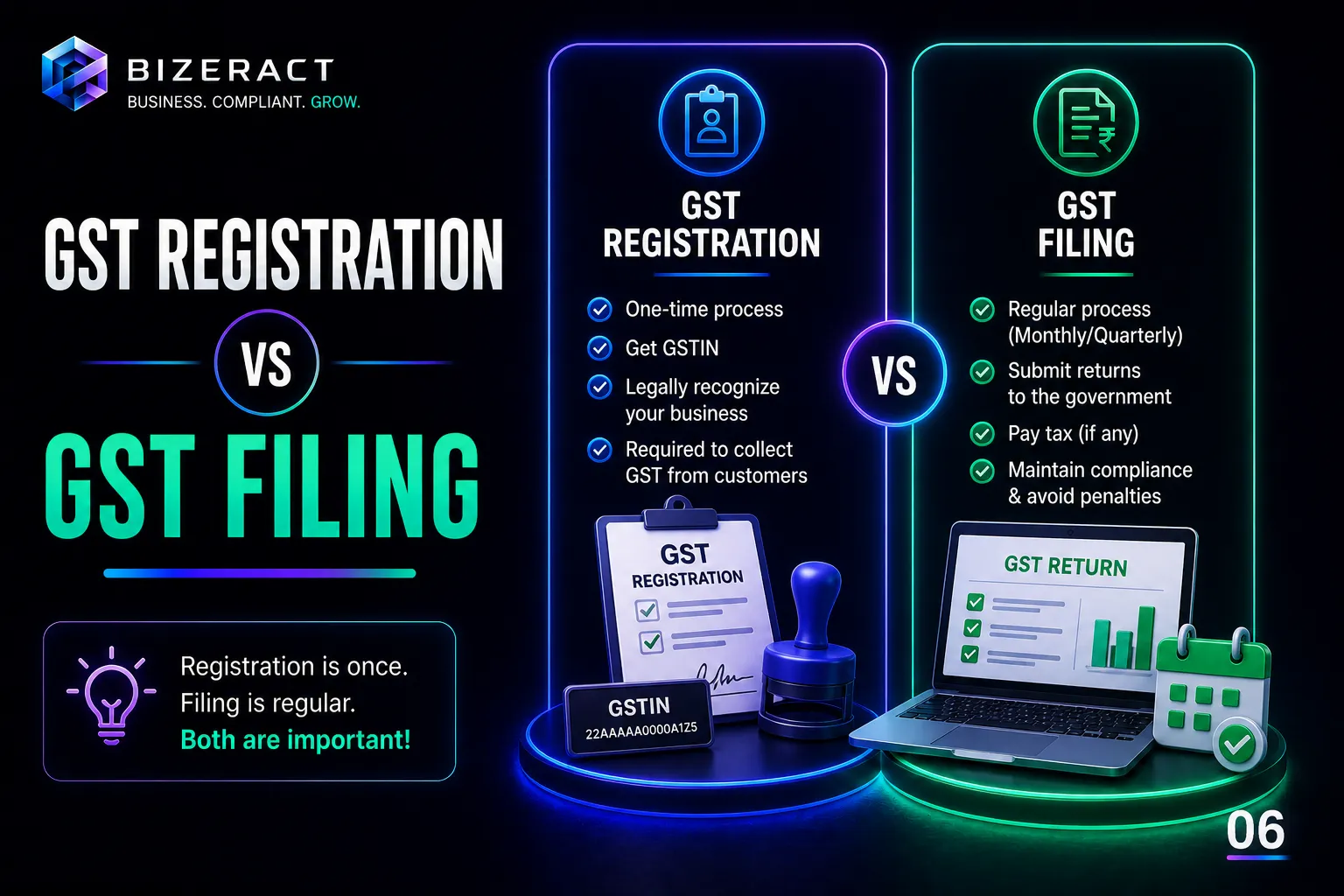
"GST registration" and "GST filing" sound like the same thing. They're not. Mixing them up is one of the most frequent - and expensive - mistakes small business owners make when they first deal with GST.
Source check: registration should be verified on the official GST portal, while recurring filing rules can be cross-checked in GSTN's GSTR-1 guide and GSTR-3B FAQ.
GST Registration: a one-time event
GST registration is the one-time process of getting your business onto the GST system. You apply on the GST portal, submit identity and address proofs, and the government assigns you a 15-digit GSTIN (GST Identification Number). After that, you're a registered taxpayer.
Registration happens once per business per state. If you open a new branch in another state, that branch gets its own GSTIN - but the process is still a one-time event per state.
GST Filing: a recurring obligation
Once you're registered, GST filing begins - and doesn't stop until you surrender your GSTIN. Filing means submitting monthly or quarterly returns that declare:
- How much you sold (outward supplies) - filed in GSTR-1
- How much you owe in tax (summary) - filed in GSTR-3B
- Annual reconciliation - filed in GSTR-9 (for turnover > ₹2 crore)
Filing is required even if you had zero sales in a given period - a nil return must still be filed. Missing a filing deadline triggers late fees of ₹50/day (₹20/day for nil returns), capped monthly but still painful if you accumulate months.
The most common confusion
Business owners often believe they're "done with GST" after registration. They're not. Registration enables filing. Filing is the ongoing compliance that keeps your GSTIN in good standing.
After 6 consecutive months of missed filings, the officer can cancel your GSTIN - and you'll need to apply for fresh registration all over again, along with paying all past dues plus penalties.
Typical timeline for a new business
- Day 0: Apply for GST registration
- Day 1: Receive GSTIN certificate
- Day 11 of next month: File GSTR-1 (outward supplies) for your first month
- Day 20 of next month: File GSTR-3B (summary + tax payment) for your first month
- Every subsequent month: Same cadence
What does each cost?
Registration: government fee is zero. Professional fees range ₹499 to ₹3,000 depending on the service provider. Filing: per-return fees start around ₹500/month for a small business doing standard GSTR-3B + GSTR-1. Complex filings (multiple branches, reconciliations, refunds) cost more.
Our GST registration bundle includes your first month's filing free - that's a shortcut past the "what do I do on day 30?" question that trips up most new registrants.
Summary table
| Aspect | Registration | Filing |
|---|---|---|
| Frequency | One-time per state | Monthly/quarterly |
| What it produces | A GSTIN | A return + tax payment |
| Penalty for skipping | 10% of tax due, min ₹10,000 | ₹50/day (₹20/day nil) |
| Required forever? | No (one-time) | Yes, while registered |
Further reading: GST registration for small business covers thresholds and composition scheme fit; GST registration fees in India breaks down exactly what you pay at each stage.
What to verify before acting on GST Registration vs GST Filing
Rules and platform behaviour change after an article is published. Confirm thresholds, registration status, return forms, document rules, and portal notices against the GST Portal before you act on anything below, because the right answer depends on your entity, state, turnover, and current setup.
Going deeper: GST Registration, GST Registration for Small Business, and GST Registration Fees.
Frequently asked questions
What is the short answer on GST Registration vs GST Filing?
GST registration and GST return filing are two separate things - and confusing them costs small businesses penalties. Clear breakdown of what each means. The practical next step is to compare the article checklist with your business model, state, turnover, documents, and tools before you act.
What should I verify before using this guide?
Verify the latest thresholds, filing dates, forms, documents, and portal guidance from the official source links on this page. Tax rules, ad platform policies, software APIs, marketplace requirements, and search documentation can change after publication.
When should I get professional help?
Get help when the decision affects GST registration, tax filing, paid media budget, production website performance, analytics accuracy, or business-critical automations. A short expert review usually costs less than penalties, rework, bad data, or failed implementation.
Let's talk about your business.
Tell us what you're working on and where you want to go. We'll put together a plan. No obligation, no sales pitch.
- Free 30-minute call
- A plan built around your goals
- No obligation, no pressure
- Your own account manager