GST Registration for ONDC Sellers in India: 2026 Guide
ONDC seller GST guide - who needs GSTIN, business registration options, seller app onboarding, documents, benefits, tax setup, and common approval mistakes.
- ONDC seller GST needs depend on category, seller app, business model, taxable supplies, and whether the seller already has GSTIN.
- Prepare business, bank, catalogue, tax, pickup, and fulfilment details before onboarding through an ONDC seller network participant.
- Treat ONDC as an open commerce network, not a single marketplace; compliance checks can vary by seller and buyer applications.
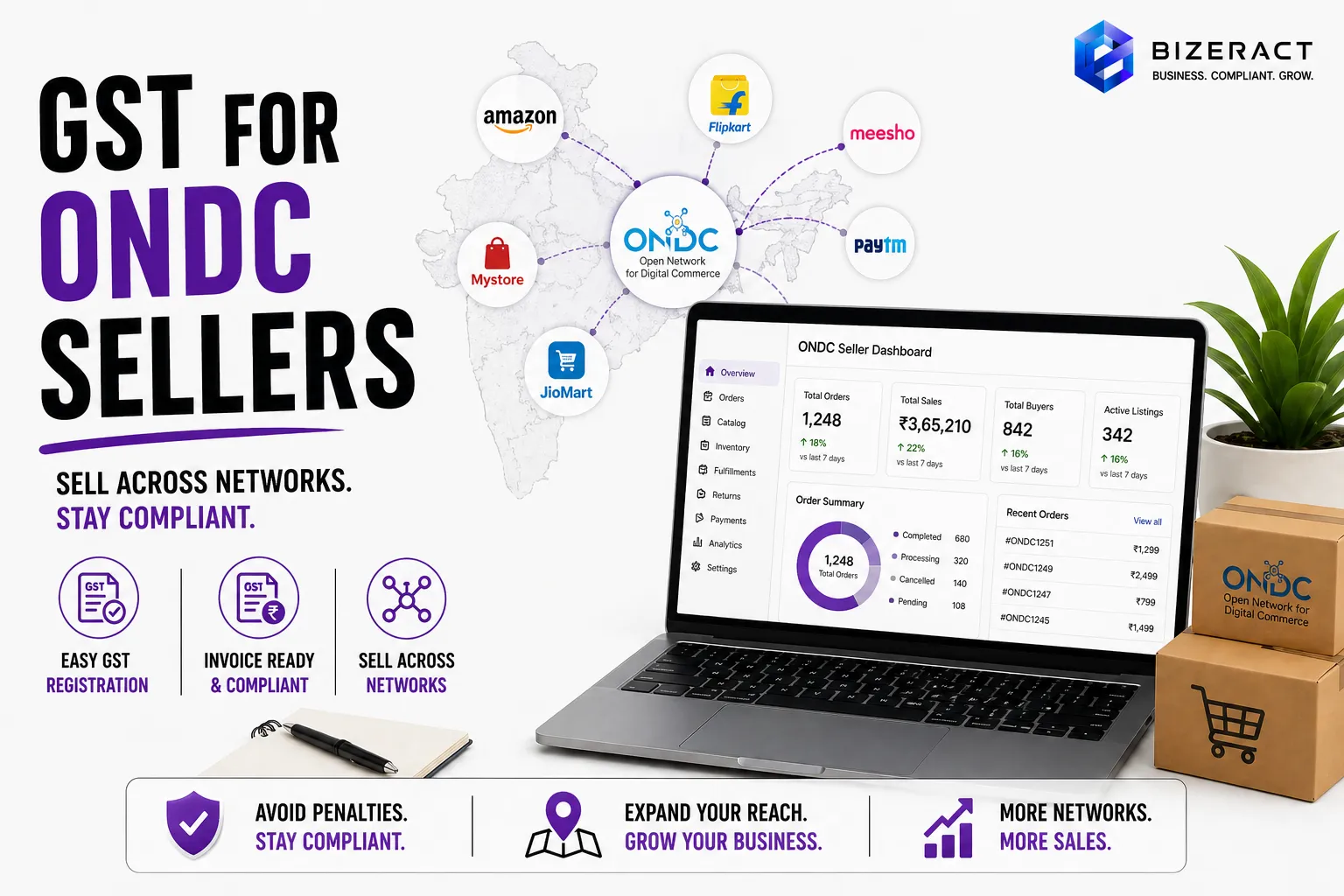
ONDC says sellers join through seller network participants and become visible across buyer applications. Seller apps commonly ask for GSTIN, bank account, business details, and catalogue data before onboarding. ONDC is the authority for the platform rule itself; GST liability is decided separately by law and reconciled through the GST portal.
Why ONDC Network asks for a GSTIN before you can list
The GST portal’s Form GSTR-8 FAQ says e-commerce operators report taxable supplies and the TCS they collected for registered suppliers, normally by the 10th of the following month (GST Portal). That reporting only works if the supplier behind each order is a registered, identifiable taxpayer, which is why ONDC Network gates listings on GSTIN verification. ONDC is not one marketplace dashboard. Your seller app, buyer app, logistics partner, payment flow, and invoice process must all point to the same business identity.
The GST Council’s 53rd meeting recommended cutting the e-commerce TCS rate from 1% to 0.5% total to ease working-capital pressure on suppliers (GST Council). The deduction still happens every settlement cycle, so a seller without clean GST records loses track of the credit quickly.
Who needs to register for ONDC Network?
ONDC sets out the platform-side onboarding rule and GST law decides the tax liability (ONDC). Marketplace triggers can bite from the first taxable sale rather than at a turnover figure. Registration is usually needed by these sellers:
- Retailers joining ONDC through a seller network participant
- Restaurants, grocery stores, and local shops moving online
- D2C brands that want discovery across buyer apps
- Inventory sellers handling their own catalogue and fulfilment
- Businesses that want a lower-dependency alternative to closed marketplaces
Register voluntarily anyway if buyers ask for GST invoices, if your input costs carry heavy GST, or if you plan to add channels within the next six months.
Do you need ONDC Network GST registration right now?
Use this matrix before spending money on entity or seller setup. It reflects the triggers that apply to marketplace selling specifically.
| Your situation | Recommended action | Why it matters |
|---|---|---|
| You join through a seller app as an inventory seller | Prepare GSTIN unless the category participant says otherwise | Seller apps control onboarding checks. |
| You are a small offline shop going online | Check GST, bank, catalogue, and licenses first | ONDC routes sellers through seller network participants. |
| You sell regulated goods | GST is not the only approval | Food, cosmetics, health, and similar categories may need extra licenses. |
Business structure for ONDC Network sellers
Most first-time sellers begin as proprietors because it is fast and cheap. The right entity depends on risk, partners, brand ownership, and funding plans rather than on the channel.
| Structure | Best for | Registration notes |
|---|---|---|
| Proprietorship | Solo seller testing demand | Uses owner PAN; fastest GST route |
| Partnership | Two or more family or trading partners | Partnership deed and firm PAN recommended |
| LLP | Partners who want limited liability | Needs LLP incorporation, agreement, and DSC |
| Private Limited | D2C brand, investors, multiple shareholders | Best for brand ownership and fundraising |
Documents needed for ONDC Network
Marketplaces re-verify GST details against the portal during onboarding, so a mismatch stalls the account before the first sale. Keep these consistent before you apply:
- PAN of proprietor, firm, LLP, or company
- Aadhaar and photograph of proprietor or authorised signatory
- Bank proof: cancelled cheque or bank statement with account name and IFSC
- Business address proof: electricity bill plus rent agreement or owner NOC
- Trade name, product categories, HSN codes, and pickup or warehouse address
- Seller app onboarding details
- Store catalogue, pickup pin codes, and fulfilment rules
- FSSAI, trade license, or category approvals where applicable
If you operate from home, use the latest electricity bill and an owner NOC when the property is not in your name. If inventory sits in another warehouse, add that location properly instead of treating it as an informal pickup point.
What GST registration gets you on ONDC Network
TCS reported by the operator is reflected in the supplier’s electronic cash ledger, so registration is what turns a deduction you cannot avoid into a credit you can actually use (GST Portal).
- Show products across multiple buyer apps after onboarding
- Keep more control over pricing, catalogue, and customer reach
- Use GST identity across store, seller app, and settlement records
- Claim ITC on digital commerce, packaging, and logistics costs
- Build an open-network channel alongside marketplaces and own website
In seller onboarding work the highest-friction cases are rarely tax-rate disputes. They are identity mismatches: owner PAN differs from the bank name, the pickup address differs from GST records, or the store name does not match the trade name.
Setting up ONDC Network step by step
GST registration itself is online and carries no government fee. What gates you is ONDC Network approval, which depends on clean supporting data. Use this sequence so you do not have to redo onboarding after verification.
- Choose a seller network participant or seller app
- Prepare GSTIN, bank, business name, address, and catalogue details
- Map product categories, HSN, fulfilment pin codes, and serviceability
- Set tax-inclusive pricing and return rules
- Test order, invoice, settlement, and cancellation flow
- Reconcile ONDC seller app reports with GST returns monthly
Keep the ARN, GST certificate, bank proof, and approval emails in one folder. They are needed again for category approval, warehouse updates, bank changes, and account-health reviews.
Common mistakes to avoid
The GST Council noted that TCS credits create working-capital pressure when sellers cannot reconcile them cleanly (GST Council). These mistakes make that worse:
- Thinking ONDC itself operates the seller account
- Registering through one app but keeping GST and bank names inconsistent
- Launching without testing invoice and cancellation flows
- Ignoring category licenses for food, health, cosmetics, or regulated goods
The safest rule is to make GST, bank, address, invoice, and seller profile data identical before the first order. Fixing mismatches afterwards is slower and riskier.
Frequently Asked Questions
Is GST needed for ONDC?
Most seller apps ask for GSTIN for taxable sellers, but requirements can vary by category and seller participant. Check before onboarding.
Is ONDC the same as Amazon or Flipkart?
No. ONDC is an open network. Sellers connect through seller applications and become discoverable across buyer applications, instead of operating inside one marketplace.
Can small shops join ONDC?
Yes. ONDC is designed for offline and online sellers. Small shops still need clean business, bank, tax, catalogue, and fulfilment details before selling.
What should you do next?
ONDC Network registration is easiest when business identity is settled first: entity, PAN, GSTIN, bank, address, HSN, and invoice flow. If those are clean, approval is a process task. If they are messy, even a strong catalogue gets stuck.
For a faster setup, start with GST registration for e-commerce sellers, compare GST documents required, or use 24-hour GST registration before you open the account.
What to verify before acting on GST Registration for ONDC Sellers in India
Rules and platform behaviour change after an article is published. Confirm thresholds, registration status, return forms, document rules, and portal notices against the GST Portal before you act on anything below, because the right answer depends on your entity, state, turnover, and current setup.
| Checkpoint | Why it matters | Where to confirm |
|---|---|---|
| Current rule or platform status | Limits, forms, policies, and APIs can change after a blog update. | GST Portal |
| Your exact business case | A local shop, freelancer, D2C store, agency, and SaaS team rarely need the same next step. | Documents, invoices, campaign data, analytics setup, or workflow logs |
| Implementation evidence | The safest business decision is backed by proof, not memory or screenshots from an old setup. | Portal acknowledgement, dashboard export, invoice sample, test lead, or error log |
Going deeper: GST Registration for E-commerce, GST Registration for Small Business, and GST Registration for Small Business.
Frequently asked questions
Is GST needed for ONDC?
Most taxable sellers should prepare GSTIN, but exact onboarding checks depend on the seller network participant, category, and business model.
Is ONDC the same as Amazon or Flipkart?
No. ONDC is an open network where sellers connect through seller applications and become visible across buyer applications.
Can small shops join ONDC?
Yes. Small shops can join through seller network participants, but business, bank, catalogue, tax, and fulfilment details must be ready.
Let's talk about your business.
Tell us what you're working on and where you want to go. We'll put together a plan. No obligation, no sales pitch.
- Free 30-minute call
- A plan built around your goals
- No obligation, no pressure
- Your own account manager