E-Way Bill Rules India: Limits, Validity and Penalties 2026
Know when e-way bills apply, how validity works, which movements are exempt, and what penalties hit if goods move without one in India before dispatch.
- E-way bill requirements depend on consignment value, movement type, state rules, goods, distance, and document validity.
- Generate and preserve e-way bill details before dispatch because detention, penalty, and invoice mismatch risk starts during movement.
- Match e-way bills with invoices, transport records, and GST returns to avoid post-movement notices.
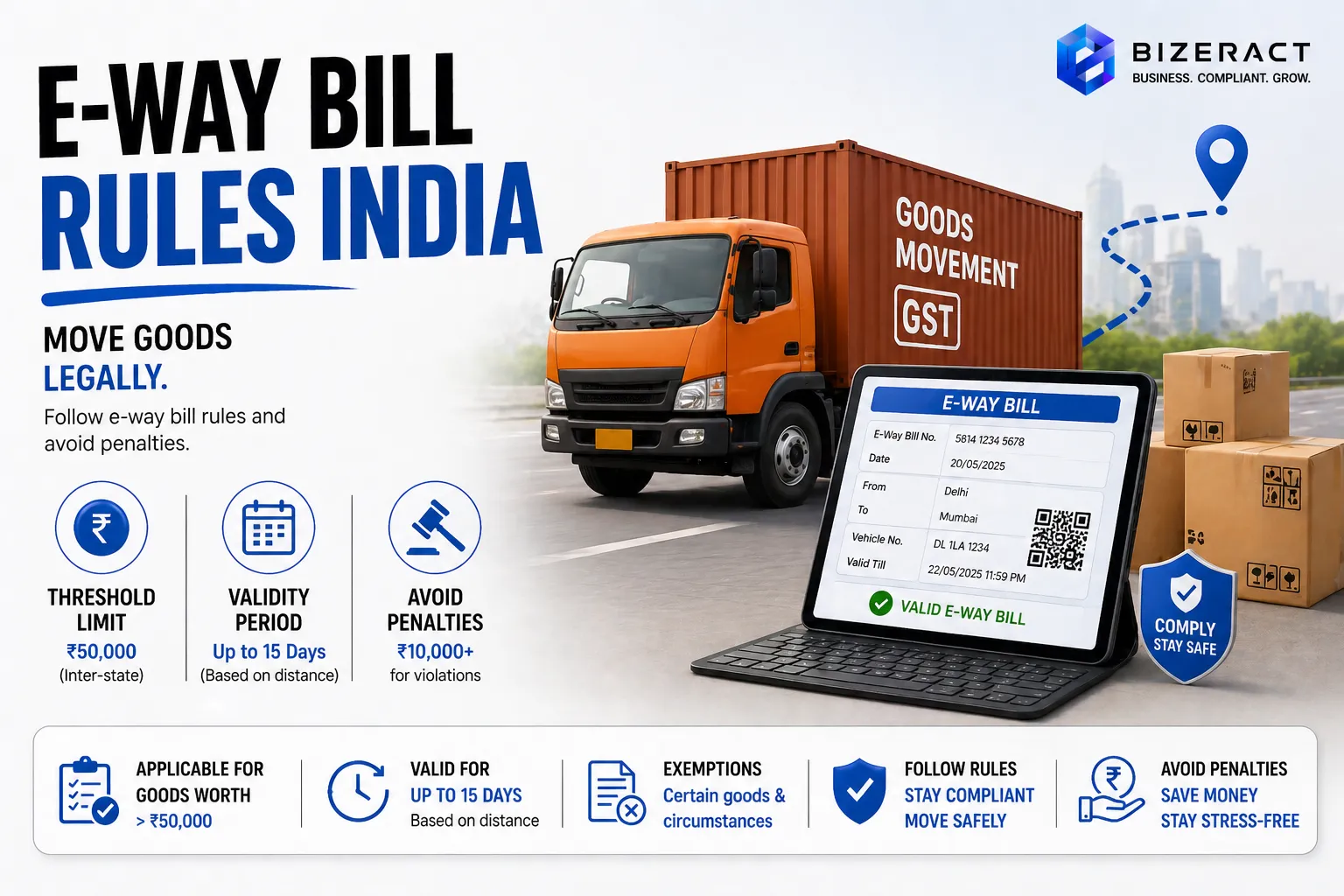
If you move goods worth over ₹50,000 across India without a valid e-way bill, the consignment can be stopped, seized, and penalised on the spot. E-way bills are the single most overlooked GST compliance - and the one that costs traders the most when ignored.
This guide explains e-way bill rules in India for 2026 - thresholds, validity, exemptions, and how to generate one in under two minutes.
What is an e-way bill?
An e-way bill is an electronic document generated on the e-way bill portal for the movement of goods. It contains supplier, recipient, transporter, and consignment details - and must accompany the goods in transit.
Who needs to generate an e-way bill?
- Any registered person moving goods worth above ₹50,000
- Transporters moving goods between states
- E-commerce operators handling delivery
- Principal or job worker in certain job-work movements
When is e-way bill NOT required?
- Goods worth less than ₹50,000 (inter-state)
- Specific exempt goods (e.g., LPG for household, jewellery, currency)
- Transport by non-motorised vehicle
- Movement within 10 km between consignor/consignee in same state (with conditions)
Benefits of generating e-way bills correctly
- Avoid on-road seizures
- No 100% penalty + tax recovery
- Clean audit trail
- Faster reconciliation with GSTR-1
- Lower insurance and transit disputes
Step-by-step: generate an e-way bill
- Log in to ewaybillgst.gov.in
- Click Generate New
- Choose supply type (outward / inward)
- Enter GSTIN of recipient / supplier
- Add invoice details - number, date, value, HSN, tax
- Fill transporter ID + vehicle number
- Submit → system generates 12-digit EBN
- Share PDF with the transporter
Validity of e-way bill
- Up to 200 km: 1 day
- Every additional 200 km: 1 extra day
- Over-dimensional cargo: separate scale (20 km per day)
- Extendable in limited circumstances
Documents to carry
- Invoice or delivery challan
- E-way bill PDF or EBN
- Transporter ID / vehicle number displayed
Penalties for missing e-way bill
- ₹10,000 or tax evaded - whichever is higher
- Detention of goods and vehicle
- Release only after payment of tax + penalty
- Reputation hit with transporters and clients
Common mistakes
- Treating intra-state ≤ ₹50,000 as always exempt - some states mandate lower thresholds
- Wrong vehicle number - invalidates the bill
- Expired e-way bill - common in transit delays; extend before expiry
- Missing Part B - transporter details left blank
- Wrong HSN - matches GSTR-1 mismatch
Frequently Asked Questions
Is e-way bill mandatory within a state?
Yes, for most states above ₹50,000. A few states have lower thresholds - check state notifications.
Can e-way bill be cancelled?
Yes, within 24 hours of generation, if the goods haven't moved.
Can an unregistered person generate an e-way bill?
Yes - through enrolment as a transporter or the registered recipient generates on their behalf.
What happens if vehicle breaks down?
Update Part B with the new vehicle number. Bill validity still counts from original generation.
Do e-commerce deliveries need e-way bills?
Yes if the consignment value exceeds threshold. See GST for e-commerce.
Can one e-way bill cover multiple invoices?
No. One e-way bill per invoice. Use consolidated e-way bill for grouping during transport.
Is e-way bill required for job work?
Yes when goods are sent between principal and job worker above threshold.
What should you do next?
E-way bills are non-negotiable for anyone moving goods in India. Build it into your dispatch workflow alongside invoicing - the two should never travel apart.
Get GST registration in 24 hours with expert support. Our CA team sets up e-way bill access alongside your GSTIN. Start with GST for traders or GST registration.
What to verify before acting on E-Way Bill Rules India
Rules and platform behaviour change after an article is published. Confirm thresholds, registration status, return forms, document rules, and portal notices against the GST Portal before you act on anything below, because the right answer depends on your entity, state, turnover, and current setup.
Going deeper: GST Registration for Small Business, GST Registration for E-commerce, and GST Registration for Small Business.
Frequently asked questions
What is the short answer on E-Way Bill Rules India?
Know when e-way bills apply, how validity works, which movements are exempt, and what penalties hit if goods move without one in India before dispatch. The practical next step is to compare the article checklist with your business model, state, turnover, documents, and tools before you act.
What should I verify before using this guide?
Verify the latest thresholds, filing dates, forms, documents, and portal guidance from the official source links on this page. Tax rules, ad platform policies, software APIs, marketplace requirements, and search documentation can change after publication.
When should I get professional help?
Get help when the decision affects GST registration, tax filing, paid media budget, production website performance, analytics accuracy, or business-critical automations. A short expert review usually costs less than penalties, rework, bad data, or failed implementation.
Let's talk about your business.
Tell us what you're working on and where you want to go. We'll put together a plan. No obligation, no sales pitch.
- Free 30-minute call
- A plan built around your goals
- No obligation, no pressure
- Your own account manager