Do Freelancers Need GST Registration in India in 2026?
When a freelancer must register for GST, when it's optional, and why voluntary registration often makes financial sense even below the threshold.
- GST is mandatory for a freelancer once annual receipts cross ₹20 lakh (₹10 lakh in the NE states, Himachal and Uttarakhand), and a GSTIN is required to claim the zero rate on exported services even though export itself is zero-rated.
- Registration turns 18% GST on laptops, monitors, Adobe/Figma/Notion, AWS and co-working into claimable ITC — effectively an 18% discount on the tools you already pay for.
- Clients who claim ITC are tax-neutral on your 18%, so B2B rates do not really rise; price B2C work more carefully, because there the 18% reads as a price increase.
- For a solo operator, proprietorship registration needs only PAN and Aadhaar with no DSC, and filing runs about 15 minutes a month or ₹500-800 done-for-you. Above roughly ₹15 lakh a year with any B2B or export mix, ITC refunds usually exceed the compliance cost.
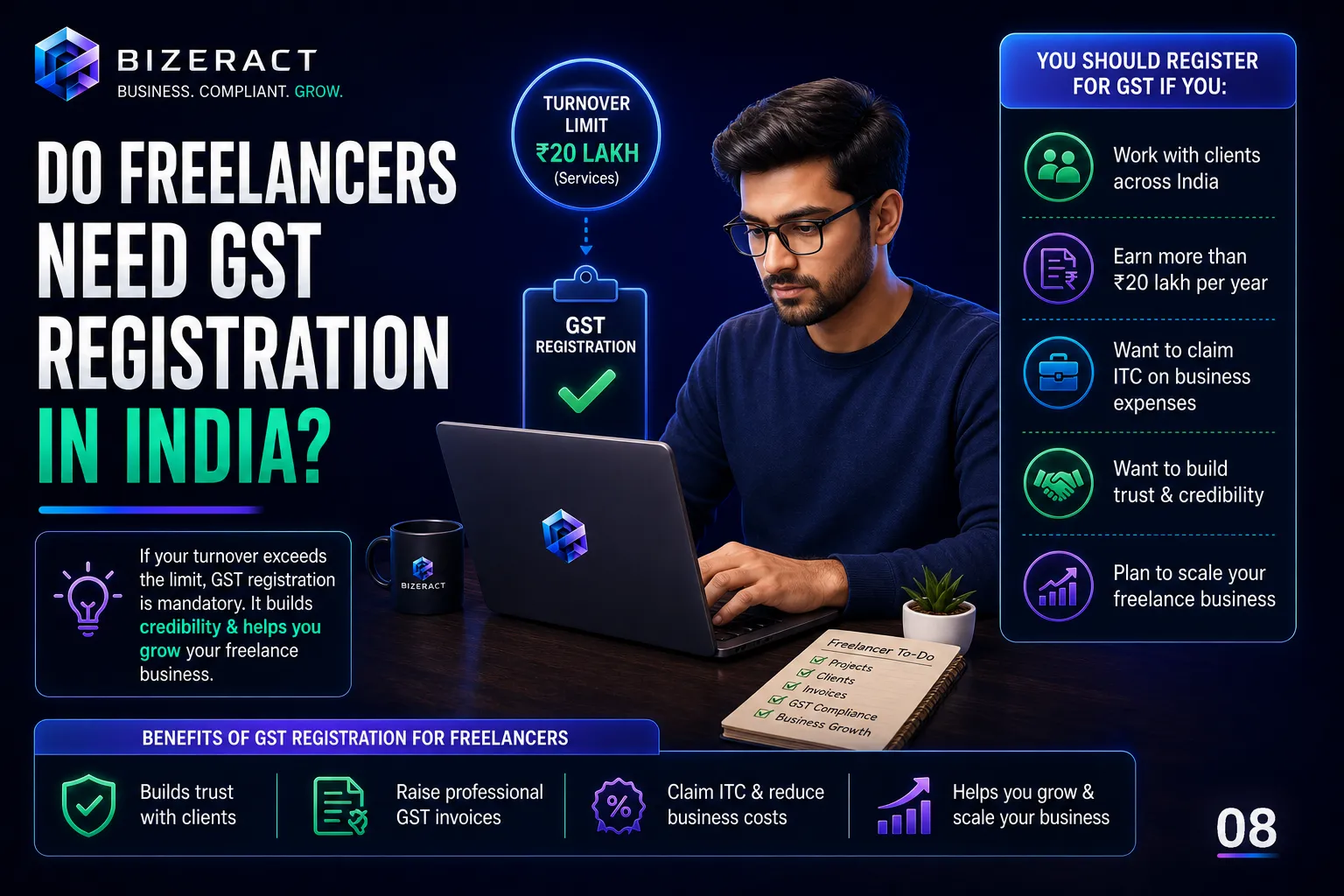
The short answer: it depends on your receipts and where your clients are. The longer answer is more useful, because voluntary GST registration often makes sense for freelancers even when the law doesn't require it.
Source check: verify threshold and filing rules on the official GST portal and use the GSTN registration guide before applying.
When GST is mandatory for freelancers
Three scenarios force registration regardless of your preference:
- Annual receipts cross ₹20 lakh (₹10 lakh if you're in NE states, Himachal, or Uttarakhand). "Receipts" means everything that hits your account - retainers, project fees, royalties, reimbursements.
- You invoice clients in other states. Interstate supply of services triggers mandatory registration from the first rupee - no threshold applies.
- You export services abroad. Export is zero-rated, but you still need a GSTIN to claim the zero-rate and refund ITC on your expenses.
When it's optional but smart
Below the threshold and serving only home-state clients? You're not legally required to register. But voluntary registration still pays off in three common freelancer situations:
- Enterprise clients. Agencies and corporates often refuse to onboard non-GST vendors - or deduct a hefty TDS when they do. A GSTIN unlocks cleaner invoicing and better negotiations.
- Foreign clients paying in USD/EUR. Zero-rated export invoicing requires registration. Without it, you're forced into awkward workarounds that your client's accounts team won't accept.
- High infra/SaaS spend. Laptops, monitors, Adobe/Figma/Notion subscriptions, AWS, co-working - GST paid on all of these becomes claimable ITC if you're registered, effectively giving you an 18% discount.
What changes after you register
You start charging 18% GST on your freelance invoices (0% for qualifying exports with forex inflow). You file GSTR-1 and GSTR-3B monthly (or quarterly under QRMP if eligible). You can claim ITC on eligible business expenses.
For solo freelancers, proprietorship GST registration is the simplest path - just PAN and Aadhaar, no DSC needed.
Common freelancer worries - answered
"Will clients stop hiring me if I charge 18% more?" No. Clients who can claim ITC are tax-neutral on GST - the 18% passes straight through to their tax return. B2C clients may see it as price hike, so you price in that segment carefully.
"What about foreign income - will GST cut into my rate?" Export of services is zero-rated when payment comes in foreign currency and service recipient is outside India. You charge 0% but still claim ITC refunds on your expenses - a net benefit.
"Is the compliance overhead worth it for a solo operator?" Filing is ~15 minutes/month with an accountant, or done-for-you at ~₹500-800/month. If you're earning ₹15L+ annually with any B2B or export mix, the ITC refunds usually exceed the compliance cost.
Getting started
Our GST registration for freelancers service is and includes the first month's filing free - which is the only month you really want help with, because it's the one where mistakes cost the most to unwind later.
Further reading: GST registration vs GST filing explains the ongoing obligation after registration, and GST registration fees in India covers what you'll actually pay at each step.
What to verify before acting on Do Freelancers Need GST Registration in India in 2026
Rules and platform behaviour change after an article is published. Confirm thresholds, registration status, return forms, document rules, and portal notices against the GST Portal before you act on anything below, because the right answer depends on your entity, state, turnover, and current setup.
Going deeper: GST Registration for Freelancers, GST Registration for Proprietorship, and GST Registration.
Frequently asked questions
What is the short answer on Do Freelancers Need GST Registration in India in 2026?
When a freelancer must register for GST, when it's optional, and why voluntary registration often makes financial sense even below the threshold. The practical next step is to compare the article checklist with your business model, state, turnover, documents, and tools before you act.
What should I verify before using this guide?
Verify the latest thresholds, filing dates, forms, documents, and portal guidance from the official source links on this page. Tax rules, ad platform policies, software APIs, marketplace requirements, and search documentation can change after publication.
When should I get professional help?
Get help when the decision affects GST registration, tax filing, paid media budget, production website performance, analytics accuracy, or business-critical automations. A short expert review usually costs less than penalties, rework, bad data, or failed implementation.
Let's talk about your business.
Tell us what you're working on and where you want to go. We'll put together a plan. No obligation, no sales pitch.
- Free 30-minute call
- A plan built around your goals
- No obligation, no pressure
- Your own account manager