MSME Registration Benefits: Why Every Small Business Needs Udyam
Udyam / MSME registration unlocks government subsidies, collateral-free loans, GeM listings, and delayed-payment protection. 100% online, 5 minutes.
- Udyam registration is free, takes about 5 minutes, and is the official recognition of an enterprise under the MSME Development Act — it replaced Udyog Aadhaar in 2020 as the single portal.
- 2026 classification: Micro up to ₹1 crore investment and ₹5 crore turnover, Small up to ₹10 crore and ₹50 crore, Medium up to ₹50 crore and ₹250 crore.
- A GSTIN is required for Udyam if the business is liable to register under GST, which is why the two are usually done together, often the same day.
- The registration is what unlocks the MSME-linked benefits — priority-sector and collateral-free lending schemes, delayed-payment protection, and tender preferences — none of which apply to an unregistered enterprise.
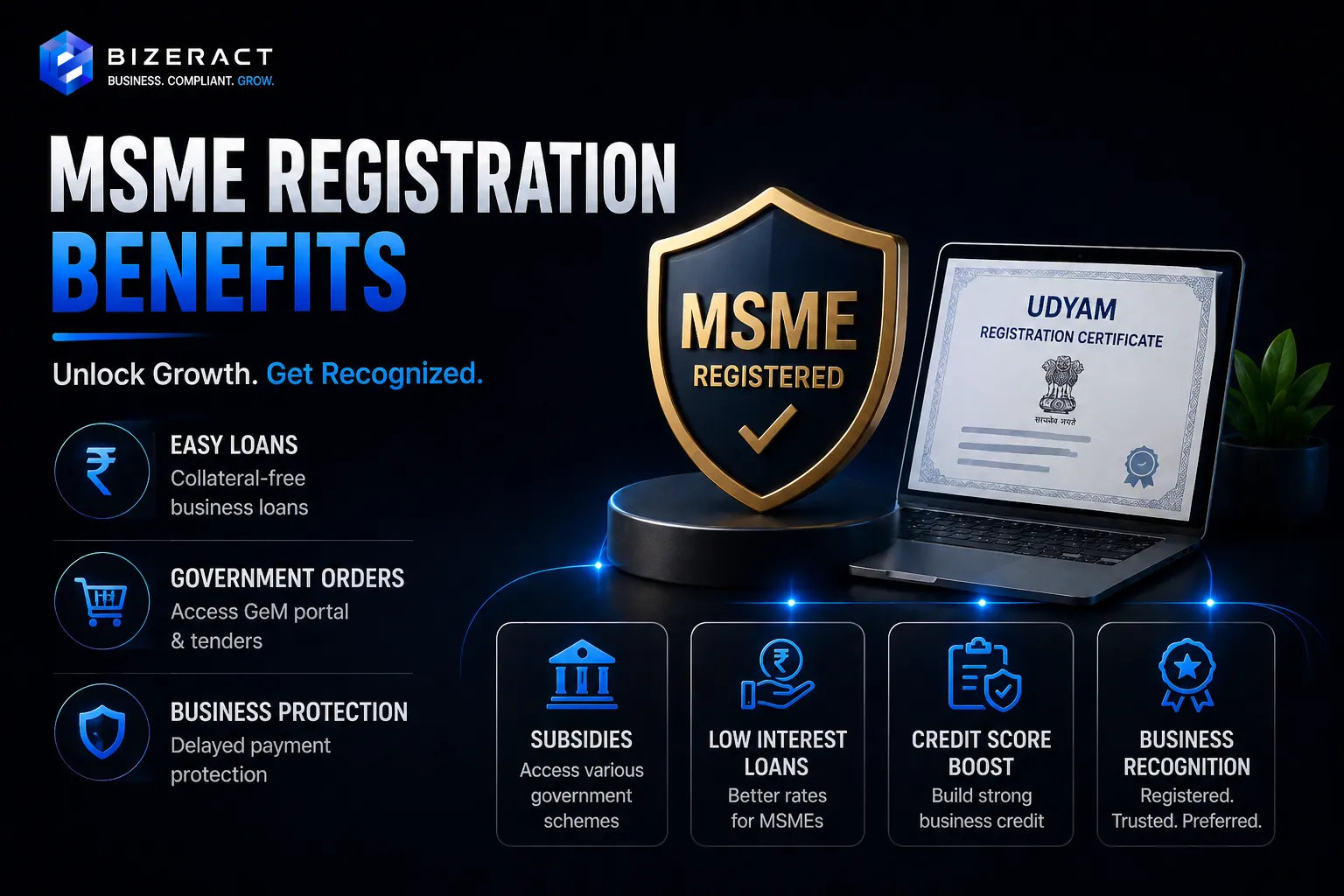
Udyam registration (formerly MSME / Udyog Aadhaar) is the single fastest way for a small business in India to unlock government benefits - subsidies, collateral-free loans, delayed-payment protection, and priority listing on the GeM procurement portal.
It takes 5 minutes, costs nothing, and most founders still skip it. This guide explains why Udyam registration is a no-brainer and how to complete it today.
Source check: use the official Udyam Registration portal for classification and process rules, and the portal's Udyam benefits note for scheme references before applying through any third party.
What is MSME / Udyam registration?
Udyam registration is the official government recognition of Micro, Small, and Medium Enterprises under the MSME Development Act. On registration, the business gets a unique Udyam number and a certificate.
MSME classification (2026)
- Micro: investment up to ₹1 Cr, turnover up to ₹5 Cr
- Small: investment up to ₹10 Cr, turnover up to ₹50 Cr
- Medium: investment up to ₹50 Cr, turnover up to ₹250 Cr
Who needs Udyam registration?
- Any manufacturing or service business below the Medium threshold
- Proprietors, partnerships, LLPs, and Pvt Ltd companies
- Freelancers and consultants (treated as service MSMEs)
- Shop owners, traders, and artisans
Benefits of MSME / Udyam registration
- Collateral-free loans under CGTMSE (up to ₹2 Cr)
- Subsidised interest on working capital loans
- Protection under the MSME Delayed Payments Act - 45-day payment cap
- Priority listing on Government e-Marketplace (GeM)
- Subsidies on ISO certification, bar code, patent filing
- Reduced electricity tariffs (state-specific)
- Eligibility for MUDRA loans and Stand-Up India
- Preference in government tenders (25% reservation)
- Faster trademark and patent processing (50% fee rebate)
Documents required
- Aadhaar number of the proprietor / partner / director
- PAN of the business
- GSTIN (mandatory for applicable businesses)
- Bank account number and IFSC
- Business activity description (NIC code)
Don't have a GSTIN yet? Start with GST registration - Udyam registration often follows within the same day.
Step-by-step: how to register on Udyam
- Visit udyamregistration.gov.in
- Click "For New Entrepreneurs who are not Registered yet as MSME"
- Enter Aadhaar + owner name → OTP verification
- Enter PAN → auto-fill of business details
- Add GSTIN, bank details, NIC codes, employment count, investment, turnover
- Submit → Udyam certificate generated instantly
Cost of Udyam registration
- Government fee: ₹0
- Professional fee (if outsourced): ₹299–₹999
- Bundled with GST registration at Bizeract
Common mistakes
- Not linking GSTIN - incomplete for taxable businesses
- Wrong NIC code - affects subsidy eligibility
- Skipping Aadhaar mismatch - Aadhaar name must match PAN
- Forgetting to update turnover yearly - recategorisation risk
- Paying for fake "MSME licences" - government Udyam is free
Frequently Asked Questions
Is MSME registration the same as Udyam?
Yes. Udyam replaced MSME / Udyog Aadhaar in 2020 as the single portal for MSME registration.
Is Udyam registration free?
Yes, 100% free on the government portal.
Can freelancers register under Udyam?
Yes - as service MSMEs. See GST for freelancers.
Do I need GSTIN for Udyam?
Mandatory if your business is required to register under GST. Otherwise optional.
How long does Udyam registration take?
5 minutes online. Certificate is generated instantly.
Can I update my Udyam details later?
Yes, via the portal. Update turnover and investment yearly.
Is Udyam useful for e-commerce sellers?
Yes - priority on GeM, faster loans, delayed payment protection. Pair with GST for e-commerce.
What should you do next?
Udyam registration is the highest-ROI compliance move a small business can make - five minutes for years of subsidies, faster loans, and tender access. There is no reason to delay.
Get GST registration in 24 hours with expert support - and we help you complete Udyam the same day. Start with GST for small business or GST for proprietorship.
What to verify before acting on MSME Registration Benefits
Rules and platform behaviour change after an article is published. Confirm registration eligibility, document requirements, certificate status, and official instructions against the Udyam Registration Portal before you act on anything below, because the right answer depends on your entity, state, turnover, and current setup.
Going deeper: MSME / Udyam Registration, Sole Proprietorship Registration, and Pvt Ltd Registration.
Frequently asked questions
What is the short answer on MSME Registration Benefits?
Udyam / MSME registration unlocks government subsidies, collateral-free loans, GeM listings, and delayed-payment protection. 100% online, 5 minutes. The practical next step is to compare the article checklist with your business model, state, turnover, documents, and tools before you act.
What should I verify before using this guide?
Verify the latest thresholds, filing dates, forms, documents, and portal guidance from the official source links on this page. Tax rules, ad platform policies, software APIs, marketplace requirements, and search documentation can change after publication.
When should I get professional help?
Get help when the decision affects GST registration, tax filing, paid media budget, production website performance, analytics accuracy, or business-critical automations. A short expert review usually costs less than penalties, rework, bad data, or failed implementation.
Let's talk about your business.
Tell us what you're working on and where you want to go. We'll put together a plan. No obligation, no sales pitch.
- Free 30-minute call
- A plan built around your goals
- No obligation, no pressure
- Your own account manager